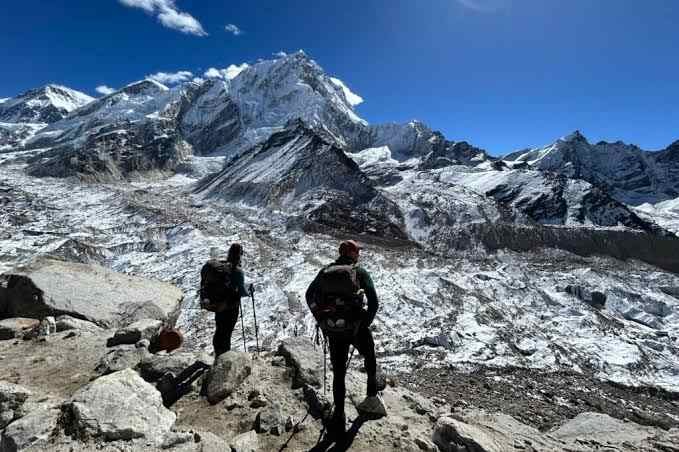
Island Peak is where trekkers become climbers. The mountain the maps call Imja Tse rises to 6,189 metres above the Chhukung valley, and combining it with the Everest Base Camp trek is the most reliable way to stand on a six thousand metre summit on your first attempt. I have taken guests up this mountain after walking them to Base Camp, and the acclimatisation you bank on the trek is exactly what carries you through summit night. This guide covers the route, the real permit costs by season, the summit day hour by hour, the gear, and the mistakes that turn people around below the headwall.
The quick facts first: Island Peak is graded PD plus on the alpine scale, the combined trip takes 19 to 20 days from Kathmandu, the climbing permit costs between USD 70 and USD 250 depending on season, and summit day runs 10 to 13 hours starting between 1 and 3 in the morning.
Island Peak at a Glance
| Fact | Detail |
|---|---|
| Official name | Imja Tse |
| Elevation | 6,189 metres |
| Alpine grade | PD plus (moderately difficult, fixed ropes on the headwall) |
| Base camp | 5,087 metres, above Chhukung |
| Summit day | 10 to 13 hours round trip, headlamp start |
| Combined trip length | 19 to 20 days with Everest Base Camp |
| Best seasons | April to May and October to November |
| First ascent | 1953, by members of the British Everest expedition as training |
The name came from Eric Shipton’s party, who looked across from Dingboche and saw a rock island standing in a sea of ice. The Nepali name Imja Tse came later, but the original description is still the best one you will hear.
Planning Your Everest Trek?
Get local expert advice on cost, itinerary and the best time to go.
Why Combine Island Peak With the Everest Base Camp Trek
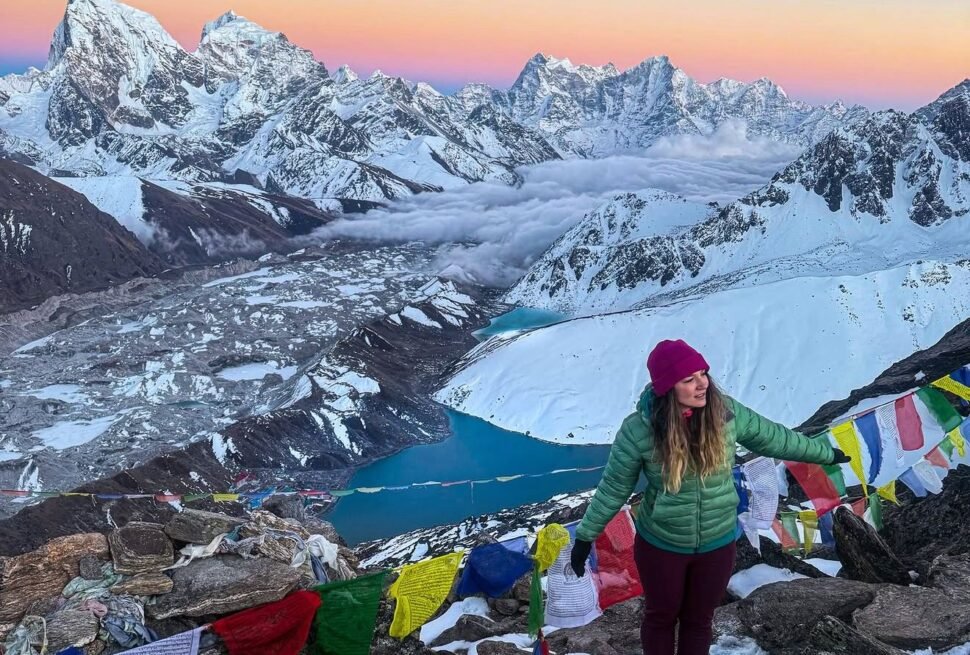
The single biggest reason people fail on Island Peak is thin acclimatisation. Flying into Lukla and heading straight for the mountain gives your body about a week to adjust before you ask it to work hard at 6,000 metres, and that is not enough for most first timers. Walking the full Everest Base Camp trek first solves the problem completely: by the time you reach Chhukung you have already slept at Gorakshep at 5,164 metres, climbed Kala Patthar at 5,545 metres, and spent close to two weeks above 3,500 metres.
On our combined departures the climb comes after Base Camp, never before. You descend from Gorakshep, cross to Chhukung at 4,730 metres over the Kongma La or via Dingboche, rest, walk two to three hours to Island Peak Base Camp, and go for the summit the next night. Your body is as ready as a trekking itinerary can make it, and it shows in who reaches the top.
Permits and What They Cost
| Permit | Cost | Where it is issued |
|---|---|---|
| NMA climbing permit, spring (March to May) | USD 250 | Nepal Mountaineering Association, through your agency |
| NMA climbing permit, autumn (September to November) | USD 125 | Nepal Mountaineering Association, through your agency |
| NMA climbing permit, winter and summer | USD 70 | Nepal Mountaineering Association, through your agency |
| Sagarmatha National Park permit | NPR 3,000 | Kathmandu or Monjo |
| Khumbu Pasang Lhamu Rural Municipality fee | NPR 2,000 | Lukla |
Island Peak is on the Nepal Mountaineering Association’s list of climbing peaks, which means the permit runs through a registered agency rather than being something you buy at a checkpoint. A refundable garbage deposit also applies to climbing permits, and your agency handles it. When you book our EBC trek with Island Peak climbing, every permit on this table is included and arranged before you land.
The Combined Itinerary
| Days | Stage | Sleeping altitude |
|---|---|---|
| 1 to 2 | Kathmandu, preparation and flight to Lukla, walk to Phakding | 2,610m |
| 3 to 5 | Namche Bazaar with acclimatisation day, then Tengboche | 3,440m to 3,860m |
| 6 to 8 | Dingboche with acclimatisation day, then Lobuche | 4,410m to 4,940m |
| 9 to 10 | Gorakshep, Everest Base Camp, Kala Patthar sunrise | 5,164m |
| 11 to 12 | Descend and cross to Chhukung, rest and gear check | 4,730m |
| 13 | Walk to Island Peak Base Camp, fixed rope training | 5,087m |
| 14 | Summit day, return to Chhukung | 6,189m high point |
| 15 | Spare day for weather | held in reserve |
| 16 to 19 | Descend to Namche and Lukla, fly to Kathmandu | decreasing |
The spare day matters more than any other line on that table. Summit weather in the Imja valley can shut the mountain for 24 hours, and itineraries without a buffer force a brutal choice between skipping the summit and missing the Lukla flight. We build the buffer in, and in most seasons it becomes a rest day rather than a rescue day.
Summit Day, Hour by Hour
| Time | Where you are | What is happening |
|---|---|---|
| 1:00 to 3:00 am | Base camp, 5,087m | Breakfast, harness and headlamp checks, roped groups form |
| 3:00 to 6:00 am | Rock gully and ridge | Steady scrambling on rock, no ropes yet, cold and dark |
| 6:00 to 7:00 am | Crampon point, about 5,800m | Boots and crampons on, rope up for the glacier |
| 7:00 to 9:00 am | Imja glacier | Crevasse crossings, sometimes on ladders, in morning light |
| 9:00 to 10:30 am | The headwall | Up to 100 metres of fixed rope climbing with an ascender |
| 10:30 to 11:00 am | Summit ridge | Short, exposed, spectacular; clipped to the line |
| 11:00 am onward | Descent | Abseil the headwall, retrace the glacier and gully |
The headwall is the part everyone asks about. It is a snow and ice slope of roughly 45 to 50 degrees with ropes fixed by the climbing sherpas, and you climb it with a jumar, one careful step at a time. It is physical rather than technical: no experience placing gear, no lead climbing, just the strength to keep moving at altitude and the composure to trust the rope. Our climbing sherpas run a training session at base camp the afternoon before, so the first time you touch a fixed line is not on the mountain.
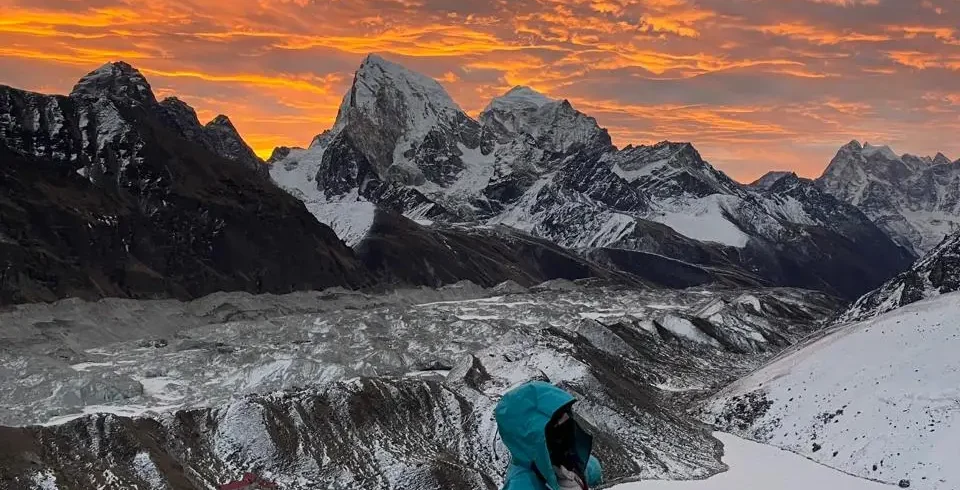
From the summit you look across the Lhotse south face, which fills the sky a few kilometres away, with Makalu, Baruntse, and Ama Dablam arranged around the horizon. Guests who have stood at Everest Base Camp two days earlier consistently say the summit view is the better of the two.
How Hard Is It Really
Island Peak is sold as a trekking peak, and the label misleads people every season. The trekking days are trekking. Summit day is climbing: 1,100 metres of ascent from base camp, most of it above 5,500 metres, with a glacier and a fixed rope wall in the middle, on three or four hours of sleep. If the Everest Base Camp trek difficulty is a 6 out of 10, summit day on Island Peak is a 8.5. What makes it achievable for fit first timers is that the hard part lasts one day, the skills are taught on the spot, and the acclimatisation from the EBC route does the invisible work.
Train for it the way you would train for the hardest single day of your life on a trail: long back to back hiking days with a pack, stair sessions, and real leg strength. Our full preparation advice is in the guide on how to prepare for the Everest Base Camp trek; for Island Peak, extend every target by about a third.
Gear: What You Carry and What You Can Rent
- Mountaineering boots (B2 or B3, crampon compatible); rentable in Kathmandu or Chhukung
- Crampons, harness, jumar ascender, belay device, two locking carabiners, helmet; all rentable as a package
- Down suit not required; a heavy down jacket, insulated trousers, and expedition mitts are enough
- Your standard EBC kit underneath it all; see the Everest Base Camp packing list
- Sunglasses rated for glacier travel and a spare pair; snow blindness ends summit bids
Renting the climbing hardware in Chhukung costs a fraction of buying it and the shops there fit boots properly because their business depends on it. What you should never rent is what touches your skin for two weeks: base layers, socks, and broken in trekking boots for the walking days.
Insurance, Safety, and the Fine Print
Standard trekking insurance usually stops at 6,000 metres and Island Peak sits above that line. You need a policy that explicitly covers climbing to 6,500 metres with helicopter evacuation, and you should read the exclusions rather than the summary page. We cover what to look for in our guide to EBC trek insurance and emergencies. On the mountain, the ratio matters: we climb with one climbing sherpa for every two guests, everyone carries a radio connection through the guide, and our summit turnaround times are fixed before you leave base camp, not negotiated on the headwall.
Altitude remains the real risk, the same as everywhere in the Khumbu. Know the symptoms before you fly; our plain language guide to altitude sickness on the EBC trek applies doubly on a climbing itinerary.
When to Climb
April and May give the warmest summit nights, the settled pre monsoon window, and the busiest fixed ropes. October and November trade a few degrees of cold for the clearest air of the year and the cheaper autumn permit at USD 125. December climbs happen and the USD 70 winter permit tempts people, but summit night cold at minus 25 degrees Celsius and wind stop most parties; it is a mountain for experienced cold weather trekkers only in that window. The month by month picture for the region is in our best time for the EBC trek guide, and it maps directly onto the climb.
Island Peak or Lobuche East
The other six thousand metre peak commonly paired with Base Camp is Lobuche East at 6,119 metres, and choosing between them is a fair question. Island Peak has the gentler approach, the established base camp infrastructure, and the single concentrated difficulty of the headwall. Lobuche East is a longer, more sustained summit day on mixed ground with bigger views over the Khumbu glacier, and it suits people with a little scrambling experience. If this is your first time in crampons, take Island Peak. If you have done a rope and crampon route before and want fewer people around you, look at our EBC trek with Lobuche Peak instead.
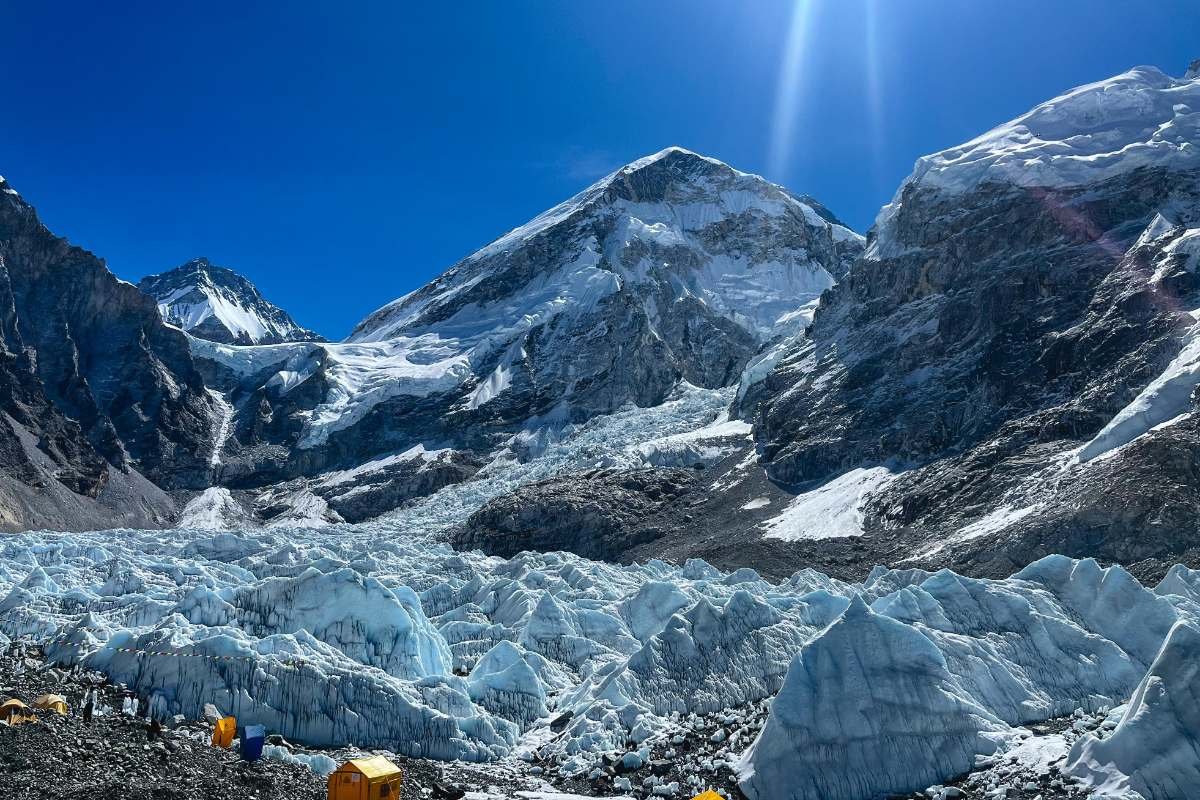
The Approach: Chhukung and the Imja Valley
Chhukung deserves more attention than it gets in most Island Peak write ups, because you will spend two or three nights there and the village makes the climb work. It sits at 4,730 metres at the head of the Imja valley, a summer yak settlement that grew into a compact cluster of lodges serving climbers and trekkers crossing the Kongma La on the Three Passes route. The lodges are simple but real: warm dining rooms, decent food, gear shops that rent everything from plastic boots to down suits, and lodge owners who watch the mountain weather the way farmers watch the sky.
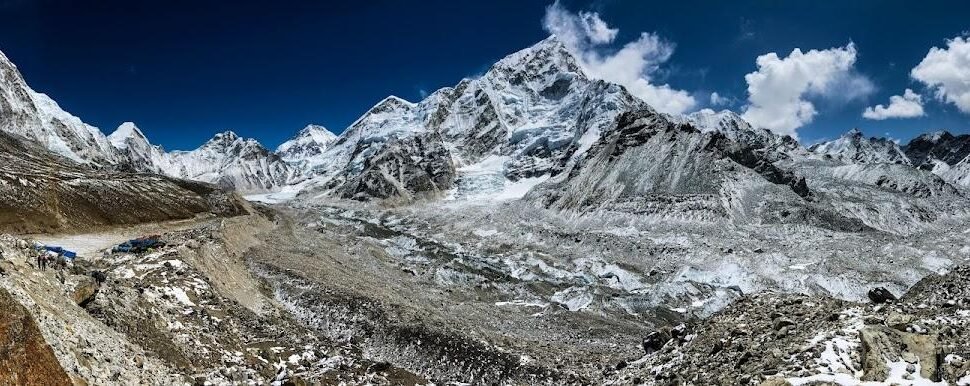
From Chhukung the walk to Island Peak Base Camp takes two to three hours up the ablation valley beside the Lhotse glacier moraine. The trail is gentle by Khumbu standards, which is deliberate mercy: you want to arrive at 5,087 metres having spent as little energy as possible. Base camp itself is a seasonal tent city on a sandy flat below the southwest flank, with expedition style dining tents, toilet tents, and sleeping tents that agencies erect for their groups. You sleep on a mattress in a proper expedition tent, eat a cooked dinner early, and try to sleep at 6pm while the sun is still on the tent fabric.
One route note that matters for planning: some operators run summit day directly from Chhukung, skipping the base camp night entirely. It saves money and a cold night, and it costs you two extra hours of walking before the climb even starts. We do not recommend it for first time climbers. The base camp night is uncomfortable and it is also the difference between starting summit day fresh at 1am and starting it already tired at midnight.
A Short History of Imja Tse
Island Peak entered mountaineering history as a training climb, and the connection to Everest runs deeper than most people know. In 1953, members of the British expedition led by John Hunt climbed it to test oxygen systems and sharpen ice skills before their attempt on Everest itself; Tenzing Norgay was among those on the first ascent party. The peak they practised on stands directly beneath the Lhotse south face, and from its summit ridge you can trace with your eyes the very route geography that decided the golden age of Himalayan climbing. The name Imja Tse was formalised in 1983, but even Nepali climbers still call it Island Peak in conversation, and the 1953 story is the one your climbing sherpa will tell at base camp.
Planning Your Everest Trek?
Get local expert advice on cost, itinerary and the best time to go.
What the Full Trip Costs
| Cost item | Typical range | Notes |
|---|---|---|
| Guided package, EBC plus Island Peak | USD 2,400 to 3,500 per person | Includes permits, climbing sherpa, base camp, group gear |
| NMA climbing permit | USD 70 to 250 | Seasonal; included in packages |
| Personal climbing gear rental | USD 80 to 150 for the trip | Boots, crampons, harness, jumar, helmet |
| Lukla flights | USD 180 to 210 each way | Usually included in packages |
| Insurance with 6,500m cover | USD 150 to 300 | Never included; arrange at home |
| Tips for guide and climbing sherpa | USD 150 to 250 total | Customary, at your discretion |
| Personal spending on the trail | USD 10 to 20 per day | Hot showers, wifi, charging, snacks |
The wide package range reflects group size, base camp quality, and the climbing sherpa ratio more than anything else. A cheap package with one climbing sherpa for six clients is not the same product as one sherpa for two, and on a fixed rope at 6,000 metres the ratio is the product. Ask the question directly before you book with anyone, including us.
Acclimatisation: Why the EBC First Sequence Works
The physiology is worth two paragraphs because it explains the whole itinerary design. Above roughly 3,000 metres your body begins compensating for reduced oxygen pressure: breathing deepens, heart rate rises, and over days to weeks your kidneys drive production of additional red blood cells. The processes that matter for a 6,000 metre summit need 10 to 14 days of progressive exposure, which is almost exactly the length of the EBC route from Lukla to Gorakshep and back down to Chhukung. The trek is, accidentally and perfectly, the ideal acclimatisation protocol for this climb.
This is also why the reverse order fails. Climb first and you meet the headwall on day seven or eight with half adjusted blood; trek first and you meet it on day thirteen with two weeks of adaptation and two successful nights above 5,000 metres already behind you. The difference shows up exactly where it hurts: in the final 200 metres of the headwall, where half adjusted climbers hit a wall of nausea and fatigue that no fitness can push through. Sleep quality at base camp improves with the same adaptation, and sleep is summit currency.
Island Peak Weather and Temperatures by Season
| Season | Summit night temperature | Wind | Conditions |
|---|---|---|---|
| Spring (April to May) | minus 10 to minus 20 C | Moderate, rising before the monsoon | Warmest window, busiest ropes, afternoon cloud build up |
| Autumn (October to November) | minus 15 to minus 25 C | Generally settled early, building late November | Clearest air of the year, cold but stable |
| Winter (December to February) | minus 25 to minus 35 C | Strong and frequent | For experienced cold weather climbers only |
| Monsoon (June to September) | minus 5 to minus 15 C | Variable | Snowfall on the glacier, poor visibility, rarely attempted |
Numbers like these decide gear lists, not just comfort. In late October, expedition mitts and a proper down jacket are survival equipment on the fixed ropes at dawn, where you move slowly and generate little heat. Cold injuries on Island Peak cluster among climbers who dressed for the trekking forecast rather than the summit forecast, and the two can differ by twenty degrees.
Turning Around: The Decision Nobody Plans For
Some percentage of every season turns around below the summit, and how that decision gets made separates professional operations from cheap ones. Our climbing sherpas hold fixed turnaround times: if you are not at the crampon point by a set hour, or not at the base of the headwall by a set hour, the day ends there. The times are agreed at the base camp briefing, before emotion and summit fever enter the conversation. A turnaround is not a failure of the trip; the trek to Base Camp, Kala Patthar, and the Kongma La crossing stand on their own. It is a rational trade against a descent in afternoon wind or a benighted climber, which are how serious incidents start on this mountain.
Weather turnarounds follow the same logic in reverse: the spare day exists so that one bad forecast does not end the attempt. Two bad days in a row is the mountain saying no for this trip, and the mountains reward people who can hear that.
Island Peak, Lobuche East, or Mera Peak
| Peak | Height | Character | Best for |
|---|---|---|---|
| Island Peak | 6,189m | Short technical crux on fixed ropes after a glacier crossing | First 6,000m summit combined with EBC |
| Lobuche East | 6,119m | Longer mixed summit day, sustained scrambling, big Khumbu views | Second peak, or fit scramblers |
| Mera Peak | 6,476m | Higher but technically easier snow slog, remote Hinku valley approach | Altitude ambition over technicality |
The three sit close together in brochures and far apart in experience. Mera is the highest and the least technical, a long cold walk on a glacier with one of the great summit panoramas in Nepal, five 8,000 metre peaks on a clear morning. Lobuche East is the connoisseur choice, harder than its neighbours per metre. Island Peak holds the middle: real climbing, briefly, with the best acclimatisation logistics of the three. If the phrase fixed rope excites rather than worries you, you are choosing correctly.
Responsible Climbing in the Imja Valley
The Imja valley is a fragile place with a famous problem: Imja Tsho, the glacial lake below the peak, grew so fast in recent decades that Nepal ran a drainage project to lower it, one of the highest engineering works of its kind ever completed. Climbers pass the story on the way in. What we control is smaller and matters anyway: everything carried to base camp leaves with us, batteries and gas canisters go back to Kathmandu, and the refundable garbage deposit on the climbing permit exists precisely to enforce this. The Nepal Mountaineering Association, which administers the climbing permits, publishes the current rules at nepalmountaineering.org, and the Sagarmatha National Park rules apply the whole way; the park is a UNESCO World Heritage Site and the entry rules exist to keep it one.
How We Run the Climb
Every departure we operate follows the shape described in this guide: full EBC acclimatisation first, a rest and training day in Chhukung, base camp night, fixed turnaround times, a one to two climbing sherpa ratio, and a spare summit day inside every itinerary. Group gear, ropes, and base camp are ours; your personal climbing hardware can be rented in Kathmandu with our help in an hour. The trek section runs exactly as our standard Everest Base Camp trek, and the full combined program with dates and pricing is on the EBC trek with Island Peak climbing page. If you are undecided between the peaks, message us with your experience and we will tell you plainly which one fits.
Dressing for Summit Day: The Layer System
| Layer | What it is | When it works |
|---|---|---|
| Base layer | Merino or synthetic top and bottom, snug fit | Worn from base camp to summit and back |
| Mid layer | Fleece or light insulated jacket | From the start; comes off on the glacier in sun |
| Insulation | Heavy down jacket, 700 fill or better | On at every stop, on for the headwall at dawn |
| Shell | Windproof and waterproof jacket and trousers | Over everything when the ridge wind starts |
| Hands | Liner gloves plus expedition mitts | Liners for jumar work, mitts between efforts |
| Feet | Liner sock plus heavy wool sock in B2 or B3 boots | One spare pair of socks in the pack, always dry |
The mistake pattern on summit day is starting too warm. You leave base camp at 1am wearing everything and within forty minutes on the rock gully you are sweating, and sweat at minus fifteen becomes a refrigeration system. Start slightly cold, carry the down jacket in the pack for the first hours, and put it on the moment you stop for the crampon transition. Our climbing sherpas run this exact sequence with guests, and it is one of those small disciplines that decides how the last two hours feel.
Everything below the climbing layers follows the standard trek kit, covered item by item in our Everest Base Camp packing list guide. The only additions Island Peak forces are the hardware, the boots, the mitts, and a headlamp with fresh batteries plus a spare, because summit day starts and can end in the dark.
Training for the Climb Itself
Everything in our Everest Base Camp training program applies, extended by roughly a third: the peak weekend should reach seven to eight hours of walking with ten kilograms rather than six hours with eight. Two additions pay for themselves on the headwall. First, step ups with a loaded pack, high box, slow tempo, because the fixed rope section is functionally forty minutes of weighted step ups at 6,000 metres. Second, grip and upper body basics, pulls and rows twice a week, because sliding a jumar and holding tension on a rope uses forearms that pure trekking never trains.
If you can find a climbing gym with a ladder or rope station, one session learning to move on a fixed line is worth three gym weeks; failing that, the base camp training session covers the skills, and what you bring is the endurance underneath them.
FAQs About Island Peak and the EBC Trek
How high is Island Peak?
Island Peak, officially Imja Tse, is 6,189 metres. Base camp sits at 5,087 metres above the Chhukung valley, which makes summit day an ascent of about 1,100 metres, most of it above 5,500 metres.
Do I need climbing experience for Island Peak?
No prior climbing experience is required, but you need strong trekking fitness. The fixed rope skills for the headwall are taught by climbing sherpas at base camp the day before the summit push. What cannot be taught on the spot is endurance, so train seriously before you come.
How much does the Island Peak permit cost?
The NMA climbing permit costs USD 250 in spring, USD 125 in autumn, and USD 70 in winter and summer. On top of that you need the Sagarmatha National Park permit at NPR 3,000 and the Khumbu municipality fee of NPR 2,000, the same two permits as the standard EBC trek.
How long is the Island Peak and EBC trek combined?
Plan on 19 to 20 days from Kathmandu to Kathmandu, including acclimatisation days in Namche and Dingboche, Everest Base Camp and Kala Patthar, the climb itself, and one spare weather day for the summit.
How hard is the Island Peak headwall?
The headwall is a snow and ice slope of roughly 45 to 50 degrees, climbed on fixed ropes with a jumar for up to 100 metres. It is physically demanding at that altitude but not technical; you do not place any gear or lead anything.
What is the success rate on Island Peak?
Parties that acclimatise on the full EBC route first summit at a much higher rate than parties that go directly to the mountain. Weather and individual acclimatisation decide the rest, which is why a spare summit day is built into a serious itinerary.
When is the best time to climb Island Peak?
April to May and October to November. Spring is warmer with more traffic on the ropes; autumn is colder with the clearest air and a cheaper permit. Winter climbs are possible but summit night cold turns most parties around.
Island Peak or Everest Base Camp: which is harder?
Island Peak is significantly harder, but only for one day. The trekking days are the same as the EBC route. Summit day adds a 10 to 13 hour push with glacier travel and fixed rope climbing above 5,500 metres, which is a full grade beyond anything on the standard trek.
What insurance do I need for Island Peak?
A policy that explicitly covers mountaineering or trekking peaks to 6,500 metres with helicopter evacuation. Standard trekking policies that stop at 6,000 metres do not cover the summit day, and insurers check altitude limits when claims arrive.
Can I rent climbing gear for Island Peak?
Yes. Mountaineering boots, crampons, harness, jumar, and helmet are all rentable in Kathmandu or in Chhukung, the last village before base camp. Rent the hardware, but bring your own broken in trekking boots and base layers.
Where is Island Peak located?
Island Peak stands in the Imja valley of the Khumbu region, eastern Nepal, inside Sagarmatha National Park. The nearest village is Chhukung at 4,730 metres, reached from the Everest Base Camp trail via Dingboche, and the peak sits directly below the south face of Lhotse.
How cold is summit night on Island Peak?
Between minus 10 and minus 25 degrees Celsius in the climbing seasons, before wind. The coldest hours coincide with the fixed rope section at dawn, when you are moving slowly, which is why expedition mitts and a serious down jacket are on the gear list.
Do I sleep at Island Peak Base Camp?
On most itineraries, yes, one night in expedition tents at 5,087 metres before the 1 to 3 am start. Some operators climb directly from Chhukung to save the camp, which adds about two hours to summit day; we recommend the base camp night for first time climbers.
Can Island Peak be climbed without the EBC trek?
It can, on a shorter itinerary via Dingboche and Chhukung, but the compressed acclimatisation lowers summit chances significantly. The combined route exists because the trek delivers exactly the 10 to 14 days of progressive altitude exposure that a 6,189 metre summit demands.
Is Island Peak worth it after Everest Base Camp?
For most guests, the summit becomes the strongest memory of the whole trip. Base Camp is a destination you walk to; Island Peak is a mountain you climb, with a rope in your hand and the Lhotse face filling the sky. The extra five to six days and the climbing cost buy a different category of experience, and trekkers who were on the fence almost never regret adding it. The ones who regret it are the ones who skipped the training.
Planning Your Everest Trek?
Get local expert advice on cost, itinerary and the best time to go.