Accommodation on the Everest Base Camp trek is teahouse-based the entire route. No camping required, no tent to carry. Understanding what teahouse accommodation actually looks like at each altitude, what it costs, and how comfort changes as you climb helps you pack the right gear and set the right expectations before you leave Kathmandu.
Teahouse Accommodation: Quick Facts
| Accommodation type | Teahouses (lodge-style guesthouses) throughout |
| Room type | Private twin or double room (most common); dorms at busy lodges |
| Beds | Wooden bed frame with foam mattress |
| Bedding | Pillow and blanket provided; bring your own sleeping bag |
| Heating | Common dining room only; bedrooms are unheated |
| Hot shower | Available at extra cost up to Dingboche; basic or absent above |
| Electricity | Basic charging via solar; often limited above Namche |
| Wi-Fi | Available (paid) at most teahouses up to Gorak Shep |
| Room cost range | $3 to $25+ per person per night depending on altitude |
What Is a Teahouse?
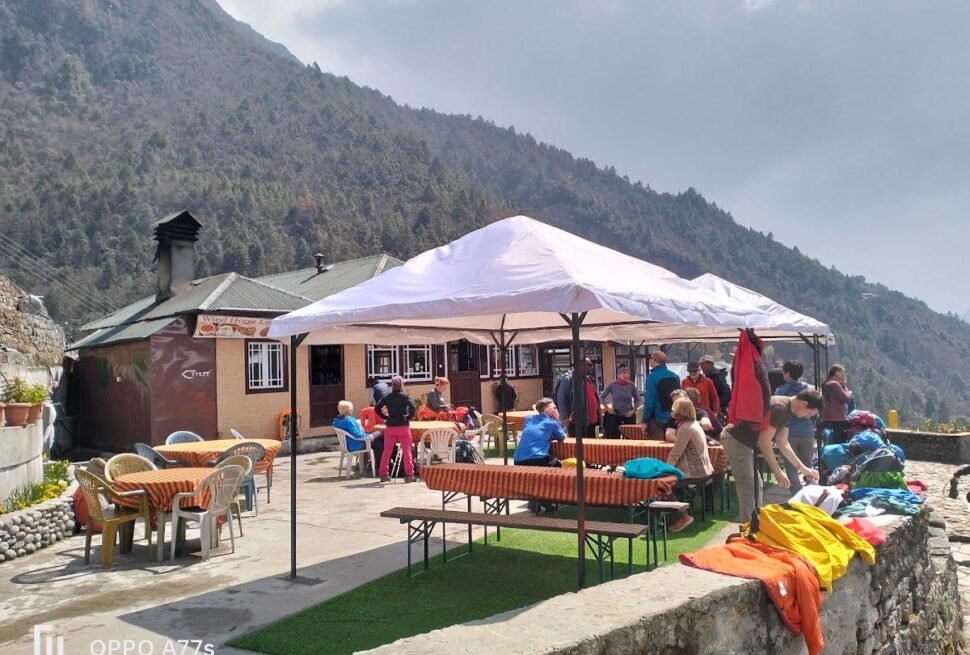
A teahouse is a trekking lodge that combines a guesthouse with a restaurant. The teahouse system in the Khumbu is among the most developed of any trekking region in the world. Teahouses range from basic two-room stone buildings in remote high camps to multi-storey lodges in Namche Bazaar with heated dining rooms, attached bathrooms, and full menus. The core model is the same everywhere: you sleep, you eat, you continue climbing.
The unwritten rule of the Khumbu teahouse system is that you are expected to eat at least some meals at the teahouse where you sleep. Rooms are often subsidized by food sales, especially at lower altitudes. Eating elsewhere and only sleeping at a teahouse can cause tension with the owner. Your guide will travel through this.
Village-by-Village Accommodation Guide
| Village | Altitude | Accommodation Quality | Room Cost/Night | Hot Shower |
|---|---|---|---|---|
| Lukla | 2,860 m | Very good; full services, attached bathrooms in better lodges | $5-15 | Yes (solar) |
| Phakding | 2,610 m | Good; standard teahouses with garden areas | $3-10 | Yes |
| Namche Bazaar | 3,440 m | Excellent; best lodges on the trail with attached bathrooms, hot showers, bakeries | $10-35 | Yes |
| Tengboche | 3,860 m | Good; fewer choices but quality lodges near the monastery | $5-15 | Yes (solar, limited) |
| Dingboche | 4,410 m | Good; multiple teahouses, last reliable hot showers | $5-15 | Yes (heated, extra cost) |
| Lobuche | 4,940 m | Basic; few teahouses, limited facilities | $5-10 | Limited/cold |
| Gorak Shep | 5,140 m | Very basic; two to three teahouses only, crowded in peak season | $5-10 | Very limited |
Lukla (2,860 m)
Most trekkers arrive in Lukla in the afternoon and overnight before starting the trail properly. Lukla has a good range of teahouses. Better lodges have attached bathrooms and hot showers. One night here, then the route begins.
Phakding (2,610 m)
A quiet village 3 to 4 hours from Lukla. Standard teahouses with basic but clean rooms. A popular first-night stop, though some operators push on to Monjo for a shorter day 2. Rooms are twin-bedded, shared bathrooms common, hot shower available.
Namche Bazaar (3,440 m)
The best accommodation on the EBC route. Namche is a proper mountain town with lodges offering attached en-suite bathrooms, unlimited hot water, heating in rooms at better properties, laundry services, and reliable Wi-Fi. You stay here twice (night 3 and acclimatization rest day), so the quality matters. Many trekkers also use this as a resupply point for snacks and gear.
Tengboche (3,860 m)
impressive setting next to Tengboche Monastery. Fewer teahouses than Namche but good quality. Rooms are standard twin with shared bathrooms. The dining rooms at Tengboche teahouses are particularly atmospheric, often heated by a central yak-dung stove. One night here on the way up.
Dingboche (4,410 m)
A key acclimatization stop (two nights). Multiple teahouses with reasonable comfort. This is the last village with reliable hot showers (solar-heated, extra cost). Above Dingboche, hot showers become inconsistent or unavailable. Rooms remain private twin, shared bathrooms, foam mattresses.
Lobuche (4,940 m)
Facilities drop noticeably here. A few teahouses on a moraine plain with cold nights and basic rooms. Bring a warm sleeping bag as bedroom temperatures drop well below freezing at night. Shared bathroom facilities, minimal hot water, small dining room with a stove. One night typically.
Gorak Shep (5,140 m)
The last stop before Base Camp. Two or three small teahouses with very basic rooms, often shared dorms during peak season due to high demand. Expect cold rooms, limited water, and crowds in October and April. The dining rooms are busy and the stoves are the only heat. Sleeping quality is often poor at this altitude due to the combination of cold, altitude, and excitement. One or two nights.
What Your Sleeping Bag Must Handle
Teahouse bedrooms are unheated at all altitudes. Even in Namche, nighttime temperatures drop to near freezing in the shoulder seasons and well below freezing at high camps. The blanket provided is inadequate above Dingboche. You need a sleeping bag rated to at least -10C (14F) for comfort at Lobuche and Gorak Shep. The EBC trek packing list covers sleeping bag ratings in detail.
Shared vs Private Rooms
Private twin rooms are available at most teahouses below Lobuche. Above Dingboche, private rooms can sell out during peak season (October, April). Booking ahead through your everest trekking company ensures rooms are reserved at each village on the standard itinerary. Walk-in trekkers during October peak can sometimes find themselves in dorms at Gorak Shep.
Electricity and Charging
| Location | Electricity Source | Charging Availability | Notes |
|---|---|---|---|
| Lukla to Namche | Micro-hydro + solar | Good, in rooms or dining room | Standard Nepal plug (Type C, D) |
| Namche Bazaar | Micro-hydro | Excellent; in rooms at better lodges | Reliable power |
| Tengboche to Dingboche | Solar primarily | Moderate; dining room charging points | Limited evening hours |
| Lobuche and above | Solar only | Limited; pay per charge at some teahouses | Bring a power bank |
A power bank (10,000 to 20,000 mAh) is essential for the upper trail. Keep it in an inner pocket to avoid cold-temperature battery drain.
Wi-Fi and Connectivity
Wi-Fi is available at most teahouses via the Nepal Telecom (Ncell) network or satellite connection. Speed is slow and unreliable above Namche. Expect to pay $2 to $5 USD per day for Wi-Fi access at most teahouses. The Nepal Telecom Everest Wi-Fi network extends to Gorak Shep. For reliable connectivity, many trekkers buy a Ncell SIM in Kathmandu.
Accommodation for Different Trek Styles
| Trek Package | Accommodation Standard | What Changes |
|---|---|---|
| Standard EBC Trek | Best available teahouse at each village | Guide pre-books rooms |
| Luxury EBC Trek | Premium lodges: Yeti Mountain Home, Summit Lodges (where available) | En-suite bathrooms, better bedding, heating |
| EBC with Helicopter Return | Best teahouses on ascent; helicopter for descent | Fewer nights at high altitude |
| EBC Trek from Jiri | Teahouses from Jiri onward; same from Lukla | First 4 to 5 days have simpler teahouses |
Luxury Lodge Options (Premium Trek)
The Khumbu now has a network of premium lodges under brands like Yeti Mountain Home (lodges in Phakding, Namche, Dole, Machermo, Gokyo) and Summit Lodges. These offer heated bedrooms, en-suite bathrooms with hot showers, restaurant-standard menus, and reliable charging. Available on the luxury EBC trek at a substantially higher price. Full luxury lodge coverage ends around Dingboche as the network thins above that altitude.
Hygiene and Facilities
Toilets: Shared squat or Western-style toilets outside the main building at most teahouses. Bring toilet paper (not always provided) and hand sanitizer. Hot water for handwashing is rarely available.
Laundry: Available in Lukla and Namche. Drying takes longer at altitude and in overcast conditions. Budget 24 hours for laundry turnaround in Namche.
Room cleanliness: Teahouses are generally clean but basic. Dust and thin walls are standard. Earplugs help if sleeping near the dining room.
Frequently Asked Questions
Do I need to bring a sleeping bag if bedding is provided?
Yes. The blankets provided at teahouses are insufficient above Dingboche. You need a sleeping bag rated to at least -10C (14F) for the upper trail. Even below this altitude, your own sleeping bag is more hygienic and warmer than teahouse blankets alone.
Are rooms on the EBC trek private?
Private twin rooms are standard below Lobuche. At Lobuche and Gorak Shep, private rooms sell out quickly in peak season. Booking ahead through your trekking company ensures room availability.
Is there heating in teahouse rooms?
No. Teahouse bedrooms are not heated at any altitude. The dining room has a central stove. Change into your sleeping clothes in the dining room if needed before heading to your cold room.
Can I book teahouses in advance independently?
Some teahouses have phone numbers or contact via WhatsApp but advance booking is difficult to manage independently. Booking through a registered everest trekking company means your guide calls ahead and rooms are reserved each day.
Teahouse Facilities by Village: Full Comparison
| Village | Altitude | Room Quality | Attached Bathroom | Hot Shower | WiFi | Charging |
|---|---|---|---|---|---|---|
| Phakding | 2,610m | Basic to moderate | Some rooms | Available (USD 2-4) | Available | Available |
| Namche Bazaar | 3,440m | Moderate to good | Some rooms | Available (USD 3-5) | Available | Available |
| Tengboche | 3,860m | Basic | Rarely | Available (USD 3-5) | Limited | Available (fee) |
| Dingboche | 4,360m | Basic | Rarely | Available (USD 3-5) | Limited | Available (fee) |
| Lobuche | 4,940m | Very basic | No | Rare | Very limited | Limited (fee) |
| Gorak Shep | 5,140m | Very basic | No | No | Rarely works | Very limited |
Teahouse Room Prices Along the Trail
| Village | Double Room (per night) | Single Room (per night) | Dorm Bed (per night) | Notes |
|---|---|---|---|---|
| Phakding | USD 5-15 | USD 4-10 | USD 3-6 | Rooms often free if you eat at the teahouse |
| Namche Bazaar | USD 8-25 | USD 6-18 | USD 5-10 | Best selection of lodges on the trail |
| Tengboche | USD 5-12 | USD 4-10 | USD 3-6 | Limited options, book early in peak season |
| Dingboche | USD 5-12 | USD 4-10 | USD 3-6 | Cold nights, good sleeping bag essential |
| Lobuche | USD 5-10 | USD 4-8 | USD 3-5 | Very basic, thin walls, bring warm layers |
| Gorak Shep | USD 5-10 | USD 4-8 | USD 3-5 | Often full in peak season, arrive early |
Most teahouses offer rooms for free or at reduced cost if you eat all meals there. This is the standard arrangement on the EBC trail.
What to Expect in a Teahouse Room
| Feature | What You Get | What to Bring |
|---|---|---|
| Bed | Single or twin beds with foam mattress | Sleeping bag (below -5C rated above 4,000m) |
| Pillow | Usually provided, quality varies | Pillowcase or buff for hygiene |
| Blanket | Provided, but may not be warm enough alone | Sleeping bag liner for extra warmth |
| Heating | Dining room has a yak dung or wood stove. Bedrooms are not heated. | Warm base layers for sleeping |
| Electricity | Available at most lodges but limited. Charging costs USD 1-3 per device. | Power bank (10,000+ mAh) |
| Toilet | Shared outdoor or indoor squat toilet at most places. Above Namche, often outdoor pit toilets. | Toilet paper (not always provided) |
| Hot shower | Solar-heated showers at most stops below 4,500m | Flip-flops for shower |
Best Lodges at Each Stop (Known for Quality)
| Village | Known Better Options | Why Popular |
|---|---|---|
| Namche Bazaar | Hotel Everest View area lodges, Khumbu Lodge | Views of Everest and Ama Dablam, better facilities |
| Tengboche | Tengboche Guesthouse, lodges near monastery | Monastery views, quiet location |
| Dingboche | Peaceful Lodge, Eco Resort | Warm dining rooms, good food quality |
| Lobuche | Pyramid International, Lobuche High Camp | Cleaner rooms than average for this altitude |
| Gorak Shep | Everest Summit Lodge, Trekkers Hotel | Close to EBC trail start, basic but functional |
More Accommodation Questions
Do I need to book teahouses in advance?
In peak season (October and April), yes. Lodges at Gorak Shep and Lobuche fill up fast. Your guide can call ahead each morning to reserve rooms for the evening. In off-season months (December-February, June-August), booking ahead is rarely needed.
Is it safe to drink tap water in teahouses?
No. Never drink tap water directly. Always use boiled water provided by the teahouse (usually free or small charge), water purification tablets, or a UV SteriPen. Above Namche, stream water may look clean but can carry parasites.
How cold do teahouse rooms get at night?
Very cold above 4,000m. Temperatures inside rooms at Lobuche and Gorak Shep can drop to -10C or colder in winter. You need a sleeping bag rated to at least -10C or -15C for these altitudes. The dining room is the only heated space.
Are there any hotels or proper guesthouses on the EBC trail?
Namche Bazaar has the best accommodation options, including some small hotels with private bathrooms and better mattresses. Above Namche, all accommodation is basic teahouse style. There are no luxury hotels above 4,000m on the standard EBC trail.
Conclusion
Teahouse accommodation on the Everest Base Camp trek is basic, atmospheric, and perfectly suited to the pace and style of trekking in the Khumbu. Bring a good sleeping bag, carry a power bank, reset your expectations for hot showers above Dingboche, and you will sleep well every night from Lukla to Gorak Shep. For the best room availability on the standard itinerary, book through a reputable everest trekking company that handles teahouse reservations as part of your package.
Teahouse Standards at Each Trek Elevation: What to Expect
Teahouse accommodation on the EBC trail has evolved significantly over the past decade. A combination of increased trekker demand, solar power installations, and owner investment has dramatically improved standards at many lodges — particularly at the main stops of Namche Bazaar, Tengboche, Dingboche, and Lobuche. Here is what to expect at each key elevation:
Phakding (2,610 m) — First Night: Phakding teahouses are warm, comfortable, and well-equipped. Most rooms have twin beds with mattresses (rather than the bare wooden bunk beds of older lodges), basic bedding including blankets and pillows, a shared bathroom with hot running water (solar-heated), and a well-stocked dining room with a wood-burning stove. This is the lowest point of the trek and consequently has the best infrastructure. A good night’s sleep here before the big climb to Namche sets the right tone for the trek.
Namche Bazaar (3,440 m) — Acclimatisation Base: Namche is the most developed trekking town in the Khumbu and has the widest range of teahouse and lodge-hotel options on the entire EBC route. At the budget end, a private room with shared bathroom costs USD 5–8/night. At the quality end, hotels like the Yeti Mountain Home or Everest Summiteers Inn offer private bathrooms, hot showers, WiFi, and comfortable beds at USD 20–50/night. For our standard EBC packages, we pre-book mid-range teahouses in Namche with reliable hot water, clean bedrooms, and good meals — the two-night acclimatisation stay here is an important transition and good sleep quality matters.
Tengboche (3,860 m) — Monastery Village: Tengboche’s teahouses are the most atmospheric on the trail, clustered around the famous monastery (the largest in the Khumbu). Standards are generally good but simpler than Namche — expect basic but comfortable rooms with shared bathrooms, reliable solar-heated water, and dining rooms that smell of woodsmoke and yak butter. The Tengboche Guesthouse adjacent to the monastery is particularly popular.
Dingboche (4,410 m) — Second Acclimatisation Stop: Dingboche teahouses are functional and well-run. At 4,410 m, the luxury of Namche is behind you but the essentials are all here: reliable rooms, hot meals, charging stations (solar-powered, USD 2–5 per device), and enough hot water for a basic wash. Some teahouses have installed gas heaters in common areas — a welcome addition on cold evenings. The Trekkers Inn and Dingboche Inn are reliable choices at this elevation.
Lobuche (4,910 m) — High Camp: Lobuche teahouses are basic — this is the honest truth. At nearly 5,000 m, the infrastructure is limited by the difficulty of getting supplies and fuel to this elevation. Rooms are small, cold, and share simple squat-toilet bathrooms. Hot water is available but limited. The dining room heated by yak-dung stove is genuinely the warmest place in the building. Bedrooms drop to near-freezing after midnight even in spring. A good quality sleeping bag (rated to at least -10°C) is non-negotiable from this point. The best teahouses at Lobuche — the Himalayan Hotel and Pyramid Hotel — are a small step above the others and worth requesting.
Gorak Shep (5,164 m) — The Summit of the Trek: Gorak Shep has just a handful of teahouses, all basic. Rooms are extremely cold, bathrooms are simple, and hot water is limited (often just a bucket of warm water brought to your door). The dining room stove is the centre of social life. Despite the basic conditions, most trekkers report that the extraordinary location and the proximity to EBC and Kala Patthar make the discomforts irrelevant — sleeping at 5,164 m is remarkable regardless of what your mattress feels like.
Luxury EBC Accommodation Options
For trekkers who want the best available accommodation at every stage, our Luxury Everest Base Camp Trek uses the highest-rated teahouses and lodge-hotels on the route. These include: Yeti Mountain Home lodges (Phakding, Namche, Kongde — stunning mountain views, private bathrooms, underfloor heating, restaurant-quality food), Summit Lodge in Namche, the Japanese-designed EBC teahouses at Dingboche with superior insulation, and a dedicated camp with insulated tent accommodation at Gorak Shep for the summit push nights.
The luxury option costs approximately USD 3,500 per person for a 13-day package but delivers a dramatically more comfortable experience above 4,000 m — particularly in the sleeping arrangements which directly impact altitude acclimatisation quality. Poor sleep quality above 4,500 m accelerates altitude sickness risk. Good accommodation is not just comfort — it is a safety investment.
Practical Accommodation Tips for EBC Trekkers
Book in advance for peak season: In October and April — the two busiest months — popular teahouses in Namche, Tengboche, and Dingboche fill 2–4 weeks ahead. Booking your full itinerary’s accommodation through your agency before departure is the only reliable way to guarantee the rooms you want. Our team at Everest Trekking Company pre-books all client accommodation before every departure.
Bring a sleeping bag liner: Even with a good sleeping bag, the addition of a silk or fleece liner adds an effective 3–5°C of warmth and provides a clean layer between you and the teahouse blankets (which are rarely washed between guests).
Ear plugs for teahouse sleeping: Teahouses are social places. Walls are thin. Yaks and dogs are active from 4:30 AM. Trekkers in adjacent rooms may snore or move at 3 AM for early starts. A good pair of foam ear plugs dramatically improves sleep quality and is one of the most underrated items in any EBC packer’s kit.
Charge devices in the dining room: Most teahouses have charging points in the dining room rather than bedrooms. Bring a power bank (5,000–10,000 mAh) to transfer a charge to your room. Solar-powered charging is available almost everywhere but capacity is limited — first come, first served each afternoon.
Do not rely on WiFi for critical communications: WiFi is available at most teahouses on the EBC route but reliability decreases significantly above Namche. Yak-powered (satellite) WiFi at higher camps is expensive and slow. Use Namche’s excellent WiFi for significant uploads, video calls, or data syncing. Above Namche, use your network connection for text-only communications and offline maps. Read our full EBC trek cost guide for a comprehensive breakdown of accommodation costs at every stage of the route and see our EBC packing list for the gear you need for a comfortable stay at high altitude teahouses.
Solo vs Group Accommodation: What Changes
How you travel affects your accommodation experience in practical ways. Solo trekkers: Some teahouses charge a solo supplement — a small addition (USD 1–3) to cover the double room that a solo trekker occupies alone. This is becoming less common as teahouses build more single-room inventory, but worth factoring into your budget. Solo trekkers booking through our agency are accommodated in standard double rooms at no supplement — we absorb the cost.
Couples and pairs: Two trekkers sharing a room is the standard teahouse booking unit. All teahouses on the EBC route have twin or double rooms. You will be accommodated together throughout the trek with a room for two at every stage. Most couples prefer to share for warmth at altitude as well as the obvious cost efficiency.
Group trekkers: Groups of 4–8 people often book an entire teahouse section at larger lodges in Namche and Dingboche. This gives groups a more exclusive experience, better meal timing, and sometimes preferential treatment from teahouse staff. Our operations team handles all group accommodation logistics — contact us for group booking enquiries.
Teahouse Etiquette: How to Be a Good Guest
Teahouses on the EBC route are run by Sherpa families, often with only 2–4 family members managing the entire kitchen, guest rooms, and front-of-house service for 20–40 guests simultaneously. Being a considerate guest makes a meaningful difference to the people who host you. Key etiquette: remove your boots before entering teahouse interiors (there is usually a shoe rack at the entrance); do not enter the kitchen unless explicitly invited; be patient at mealtimes — one cook serving 30 trekkers simultaneously at 4,000 m takes time; order your dinner meal when you arrive at the teahouse so the kitchen can plan the evening; tip your teahouse staff — they are working hard in challenging conditions; if you are leaving very early (pre-dawn for Kala Patthar), let the teahouse owner know the night before so they can prepare your breakfast and any packed food.
Respecting the religious items in and around teahouses is equally important. Prayer wheels, mani stones, and the entrance chorten at some teahouses are sacred objects. Turn prayer wheels clockwise, never counterclockwise. Walk around mani walls on the left (keeping them on your right). These small acts of respect are noticed and deeply appreciated by Sherpa hosts.
Porters and Their Accommodation: The Responsible Trekker’s Guide
An important aspect of teahouse accommodation on the EBC trail that many trekkers are unaware of: porters and guides who accompany your trek require their own accommodation. Responsible trekking agencies ensure that guides are accommodated in the same teahouse as trekkers (or in equivalent quality lodges), adequately fed and rested. Less responsible operators sometimes book guides and porters into separate, lower-quality accommodation, or share rooms 6–8 people to a space, or do not provide adequate clothing for high-altitude cold.
Our guides and porters at Everest Trekking Company are accommodated throughout the trek in appropriate teahouses — either alongside trekkers or in separate rooms at the same lodge. We provide all our high-altitude porters with proper cold-weather gear, adequate food allowances, and fair wages. When you book your Everest Base Camp Trek with us, you can be confident that the people who make your trek possible are treated with the dignity and care they deserve. For a complete breakdown of all accommodation-related costs, see our EBC trek cost guide.
Comparing Teahouse vs Hotel Accommodation on the EBC Route
As trekking infrastructure in the Khumbu has developed, a growing number of purpose-built lodge-hotels have opened alongside traditional teahouses — particularly in Namche Bazaar, Phakding, and Tengboche. Understanding the distinction helps you set accurate expectations.
Traditional teahouses are family-run guesthouses that grew organically from tea stalls serving yak herders. They are typically 10–30 rooms, run by 2–5 family members, and maintain a close connection to local culture. Meals are cooked by family members. The atmosphere is warm and personal. You will often eat dinner at the same table as the teahouse owner’s children doing their homework. This is the authentic EBC experience and what most trekkers treasure most about the trail.
Purpose-built lodge-hotels (Yeti Mountain Homes, Summit Hotels, and similar) operate more like small boutique hotels. Rooms have insulated walls, private or semi-private bathrooms, proper beds with quality mattresses, and heating options. Staff are typically trained hospitality workers rather than family members. Food quality is higher and menus are broader. The price premium for lodge-hotels is typically 3–5x the standard teahouse rate — worth it for trekkers prioritising sleep quality and comfort, particularly during the acclimatisation stops at Namche and Dingboche.
Our standard EBC packages use quality mid-range teahouses throughout. Our luxury EBC package uses the best available accommodation at each stage. Tell us your comfort preferences when booking and we will find the right balance for your trek.
What Is Included in Teahouse Room Rate
Understanding exactly what you are paying for helps avoid confusion on the trail. A standard teahouse room rate (USD 3–15 per person per night depending on elevation) typically includes: a private or shared bedroom with twin beds, basic bedding (blanket and pillow — bring your sleeping bag for warmth), access to shared bathroom facilities (squat toilet or Western toilet), and use of common areas including the dining room and stove.
Not included in the room rate (and charged separately): all meals and drinks, hot shower (USD 3–8 per shower at most lodges), WiFi (USD 2–5 per hour or per session), charging devices (USD 2–5 per device), blanket rental if you have only a summer sleeping bag, heating in the dining room or bedroom (sometimes charged as a supplement in winter), and laundry service if offered.
When you book your Everest Base Camp Trek through our all-inclusive package at Everest Trekking Company, accommodation is fully pre-booked for all nights and the price you pay covers room costs at our standard partner teahouses. You are responsible only for personal extras such as showers, additional WiFi sessions, and your own purchases at teahouse shops. This transparent all-in pricing eliminates budget surprises on the trail.
Sleeping Well at Altitude: Tips for Better Rest in Teahouses
Sleep quality above 4,000 m is significantly reduced compared to sea level, for physiological reasons that are independent of teahouse conditions. Altitude causes Cheyne-Stokes breathing — an interrupted breathing pattern during sleep — that leads to lighter, more fragmented rest. Add to this the cold, the thin walls, the early-rising culture of mountain towns, and the excitement of the trek itself, and many trekkers find sleep quality the most challenging aspect of the EBC experience.
Strategies that help: take Diamox (acetazolamide, 125mg twice daily) from Namche onwards — one of its mechanisms is reducing Cheyne-Stokes breathing, improving sleep quality significantly at altitude. Sleep with a warm hat on — the head is where most body heat escapes in a cold room. Use your sleeping bag as a duvet over the teahouse blankets rather than getting inside it — this gives you the option to quickly unzip if you overheat during the night. Avoid caffeine after 2 PM. Eat your evening meal at least 2 hours before sleeping. Keep your water bottle inside your sleeping bag to prevent it from freezing overnight and to have water immediately available when you wake. For a comprehensive medical guide to altitude sleep issues, see our altitude sickness guide for EBC trekkers.
Ready to experience the full range of Khumbu teahouse hospitality? Book your Everest Base Camp Trek with Everest Trekking Company and our team will pre-select and pre-book the best available accommodation at every stage — so all you need to do is walk, breathe, and absorb one of the world’s great mountain landscapes.
Accommodation standards on the EBC trek have improved dramatically over the past decade. From Namche upward, you will find surprisingly comfortable teahouses with clean bedding, excellent meals, and warm common rooms. The mountain hospitality of the Sherpa people makes every lodge feel genuinely welcoming. Book your Everest Base Camp Trek with Everest Trekking Company today and our team will handle all teahouse reservations in advance.
Planning Your Everest Trek?
Get local expert advice on cost, itinerary and the best time to go.