Travel insurance with helicopter evacuation cover is non-negotiable for the Everest Base Camp trek. It is not a nice-to-have — it is required by most reputable trekking companies, and for good reason. If you develop severe altitude sickness (HACE or HAPE) at Gorak Shep (5,164m), the only way to descend fast enough to save your life is by helicopter. Without insurance, you pay the full evacuation cost out of pocket — typically USD $3,000–$6,000 or more for a single rescue.
This guide explains exactly what coverage you need, what to look for in the fine print, and how to choose a policy that actually protects you.
The Essential Coverage Requirements
Any insurance policy for the EBC trek must cover:
- Helicopter rescue and evacuation to at least 5,500m altitude — this is the critical requirement. Many standard travel insurance policies have altitude limits of 4,000m or 4,500m — completely inadequate for a trek that reaches 5,645m at Kala Patthar. Check the altitude limit explicitly.
- Emergency medical treatment — for treatment at a medical facility in Nepal (Kathmandu) following an evacuation
- Medical evacuation to your home country — if you require surgery or specialist treatment unavailable in Nepal
- Trip cancellation or interruption — if you have to cut the trek short due to illness
What to Check in the Policy Fine Print
1. Maximum Altitude Covered
This is the most commonly overlooked issue with EBC trek insurance. The policy must explicitly state that helicopter evacuation is covered at or above 5,500m. Policies covering “mountaineering” or “trekking” without specifying altitude are often inadequate. Call the insurer directly and confirm the maximum covered altitude for helicopter evacuation before purchasing.
2. Activity Classification
Check how the policy classifies trekking. The EBC trek is a non-technical trek — there is no climbing, ice axes, crampons, or fixed ropes involved. However, some insurers classify any activity above 4,000m as “mountaineering” and require an upgraded, more expensive policy. Confirm that the standard trekking policy covers high-altitude trekking to EBC elevations.
3. Pre-existing Medical Conditions
Disclose any pre-existing conditions when purchasing the policy. If you fail to disclose a condition and it contributes to an incident requiring evacuation, the insurer may refuse to pay. Many standard policies cover stable pre-existing conditions — but check the policy’s definition of “stable” and the disclosure requirements.
4. Rescue Coordination
Helicopter evacuations in Nepal are coordinated through Kathmandu-based rescue companies. Most insurers require you (or your guide) to contact their emergency line before arranging a rescue, or they may not reimburse the full cost. Keep the insurer’s 24-hour emergency number stored in your phone before departure.
5. Search and Rescue
Some policies cover helicopter evacuation but not ground search and rescue. On the EBC route, most rescues are helicopter-based, so this is less of a concern than on more remote routes — but check nonetheless.
Planning Your Everest Trek?
Get local expert advice on cost, itinerary and the best time to go.
How Much Does EBC Trek Insurance Cost?
For a 2–3 week Nepal trekking trip, a suitable policy with helicopter evacuation cover to 5,500m+ typically costs USD $80–$200, depending on your age, country of residence, and the specific insurer. Older trekkers (55+) generally pay more. Annual multi-trip policies can be cost-effective if you travel frequently and include Nepal-level adventure activities.
Insurers Commonly Used by EBC Trekkers
The following insurers are commonly used by Nepal trekkers for EBC-level coverage. Always verify current policy terms directly, as products change:
- World Nomads — popular with backpackers and adventure travellers; check that the Explorer plan (not Standard) covers your required altitude
- True Traveller (UK-based) — well-regarded for adventure trekking coverage; good altitude limits
- Safety Wing — digital nomad-friendly, sometimes used for EBC; confirm altitude limits carefully
- Battleface — adventure-specific insurer with clear coverage terms
- Global Rescue — evacuation and rescue specialist; often purchased as a supplement to standard travel insurance
Note: we do not endorse specific insurers and cannot verify current policy terms. Always read the policy document carefully and call the insurer with questions before purchasing.
What Happens in a Real Evacuation
If a trekker develops severe altitude illness requiring helicopter evacuation, the standard process is:
- The guide (or teahouse owner) contacts a Kathmandu-based helicopter company and the trekker’s insurer emergency line simultaneously
- The helicopter company typically requires a credit card deposit or confirmation of insurance before dispatching the helicopter
- The helicopter flies to the nearest landing point (many stops on the EBC route have designated landing pads)
- The patient is flown to Kathmandu or the nearest medical facility
- The insurer reimburses the cost on submission of receipts and a medical report
This process means that even with insurance, you may need to provide a credit card deposit at the time of evacuation. Carry a credit card with a limit of at least USD $5,000 to cover this eventuality.
Do I Need Insurance if I Have a Credit Card with Travel Cover?
Some premium credit cards include travel insurance benefits. Check the fine print carefully — most credit card travel insurance policies do not cover high-altitude helicopter evacuation at EBC elevations. The altitude limits and activity exclusions in credit card policies are typically more restrictive than dedicated travel insurance products. Treat credit card travel cover as supplemental, not as a replacement for a dedicated EBC trek policy.
When to Purchase Insurance
Purchase your insurance as soon as you book your flights to Nepal, not the week before departure. Early purchase protects you if you need to cancel due to illness or other circumstances before the trip. Waiting until the last minute leaves you unprotected during the planning period and may limit your options if you’re ill or injured before departure.
Insurance Is Required — Not Optional
Everest Trekking Company requires all trekkers on guided EBC treks to provide proof of valid travel insurance with helicopter evacuation cover before the trek commences. This is not a bureaucratic formality — it is a safety measure that protects you, our guides, and the integrity of the rescue system. Helicopter evacuation companies in Kathmandu have had their systems abused by uninsured trekkers who cannot pay, making it harder for genuinely insured trekkers to get timely rescues.
View our Everest Base Camp Trek packages for more information, or contact our team for guidance on insurance requirements specific to your nationality and age.
Why Standard Travel Insurance Usually Is Not Enough
Most general travel insurance policies sold for holidays and business trips exclude high-altitude trekking above a certain elevation, commonly somewhere between 3,000 and 4,000 meters, precisely the range where the Everest Base Camp trail spends most of its time above Namche Bazaar. A policy purchased quickly online without reading the altitude clause can leave a trekker completely uncovered for the exact activity they are undertaking, discovering the gap only if something actually goes wrong on the trail.
Insurers price high-altitude trekking as a distinct risk category because the two things most likely to require an evacuation on this route, altitude sickness and a fall or injury on uneven terrain, are both more probable above 4,000 meters than in the destinations standard policies are built around. This is why we ask every client to confirm their policy explicitly covers trekking up to at least 5,545 meters, the elevation of Kala Patthar, before departure.
What a Proper Trekking Insurance Policy Should Cover
At minimum, a policy suitable for this trek needs to cover emergency helicopter evacuation, hospital treatment in Nepal, trip cancellation or interruption, and lost or delayed baggage. Emergency evacuation is the single most important line item, since a helicopter rescue from high in the Khumbu can run into the tens of thousands of dollars if paid out of pocket, and insurers vary considerably in how quickly they authorize a rescue once contacted.
Look specifically for a policy that names helicopter evacuation for altitude sickness, not just for traumatic injury, since some cheaper policies only trigger evacuation coverage for accidents and exclude altitude-related illness, which is actually the more common reason for an emergency descent on this route. A policy should also cover treatment at a hospital in Kathmandu, since evacuated trekkers are typically flown directly there rather than to a smaller regional facility.
Insurers Commonly Used by Our Trekkers
World Nomads, True Traveller, and IMG Global are among the insurers most frequently used by our international clients, largely because each offers policies with an altitude range that explicitly covers trekking to Everest Base Camp and beyond, and because their claims processes are relatively well understood by trekking operators across Nepal. We do not receive any commission from these companies and recommend them purely because we have seen their claims process work in practice for past clients.
Whichever insurer you choose, we strongly recommend calling or emailing them directly before purchase to confirm, in writing, that your specific policy covers trekking to at least 5,550 meters and includes helicopter evacuation for altitude sickness specifically, not only for accidents. Screenshots or email confirmations of this exchange are worth keeping, since verbal assurances from a call center are harder to enforce if a claim is later disputed.
How Helicopter Evacuation Actually Gets Triggered
When a guide identifies a trekker showing signs of moderate to severe altitude sickness, or a significant injury, the decision to call for a helicopter evacuation is made on the ground by our lead guide, who is trained to recognize the warning signs and does not wait for the trekker’s own assessment, since impaired judgment is itself a symptom of worsening altitude illness. The guide contacts our Kathmandu office and the trekker’s insurer simultaneously, and in most cases a helicopter can reach even the higher villages on the route within one to two hours in good weather.
Insurers typically require either a guarantee of payment or a credit card authorization before dispatching a helicopter, which is why we ask every client to carry their insurer’s emergency contact number and policy details physically on their person during the trek, not just saved on a phone that may run out of battery or lose signal. Our guides also carry this information for each client as a backup, precisely to avoid delays at the moment they matter most.
What Insurance Does Not Typically Cover
Pre-existing medical conditions are frequently excluded unless specifically declared and accepted by the insurer at the time of purchase, so trekkers with conditions such as heart disease, asthma, or diabetes should disclose them upfront rather than risk a denied claim later. Most policies also exclude claims arising from trekking without a guide in an area where local regulation requires one, which is now the case throughout the Everest region following Nepal’s guide requirement for independent trekkers.
Voluntary descent for comfort rather than medical necessity, such as simply deciding the trek is harder than expected and wanting a helicopter ride down, is not covered by evacuation insurance and would be charged at full commercial rate, which can run several thousand dollars depending on the pickup location. This distinction matters because a small number of trekkers each season attempt to use insurance as a shortcut off the mountain rather than reserving it for genuine emergencies, and insurers investigate claims closely enough that this rarely succeeds.
Trip Cancellation and Interruption Coverage
Beyond medical coverage, a complete policy should include trip cancellation protection in case illness, injury, or a family emergency forces you to cancel before departure, and trip interruption coverage in case the trek itself is cut short partway through. Given that flights to Lukla can be delayed for multiple days in a row, interruption coverage that accounts for missed connecting flights due to Lukla delays is a detail worth checking specifically, since not every policy treats this scenario the same way.
Cancellation coverage typically reimburses non-refundable costs such as international flights and any trekking permits or deposits already paid, provided the reason for cancellation falls within the policy’s covered list of circumstances. Reading this list before purchase, rather than after a problem arises, is the only way to know whether your specific situation would actually be covered.
Documentation to Bring on the Trek
We ask every client to carry a printed or offline-accessible copy of their insurance policy number, the insurer’s 24-hour emergency contact number, and a summary of their coverage limits, since mobile signal and battery life cannot be relied upon in an emergency at altitude. Our guides keep a master list of every client’s insurance details as a backup, cross-checked against the documents clients themselves carry, so there are two independent points of access to this information if one is unavailable.
It is also worth carrying a copy of any pre-trip medical disclosures made to your insurer, along with a basic list of any medications you are taking, in case treating physicians in Kathmandu need this information quickly during an evacuation. None of this paperwork adds meaningful weight to your pack, and the small effort of preparing it in advance can materially speed up the response if it is ever needed.
Cost of Travel Insurance for This Trek
Policies suitable for Everest Base Camp trekking typically range from roughly seventy to one hundred and fifty US dollars for a two to three week trip, depending on the trekker’s age, home country, and the specific coverage limits chosen. This is a small fraction of the total trip cost and an even smaller fraction of what an uninsured helicopter evacuation or hospital stay would cost if paid directly, which is why we consider it a non-negotiable part of preparation rather than an optional extra.
Older trekkers or those with pre-existing conditions may see higher premiums, and it is worth shopping among two or three insurers rather than accepting the first quote, since coverage terms and pricing for high-altitude trekking can vary meaningfully between providers even at similar price points.
How We Verify Insurance Before Departure
As part of our standard pre-trek preparation, we ask every client to submit their insurance policy details, including the policy number and emergency contact information, at least two weeks before departure. Our team reviews this to confirm the altitude coverage and evacuation terms are adequate for the specific itinerary booked, and we flag any gaps we notice so clients have time to adjust their coverage before flying to Nepal.
This step has caught real problems in the past, including clients who had purchased a general travel policy that excluded trekking above 3,000 meters without realizing it. Catching this two weeks out, rather than discovering it mid-trek, is exactly the kind of preparation that separates a well-run trekking operation from one that leaves insurance entirely up to the client.
Filing a Claim After Your Trek
If you needed medical treatment, an evacuation, or incurred other covered expenses during your trek, keep every receipt, medical report, and evacuation confirmation you are given, since insurers require documentation to process a claim and gaps in paperwork are the most common reason claims are delayed or reduced. Our guides can provide a written incident report on request, describing what happened, the decisions made on the ground, and the timeline of any evacuation, which many insurers accept as supporting evidence alongside medical documentation from the treating hospital.
Most insurers ask that claims be filed within a set window after returning home, often thirty to ninety days, so it is worth starting the paperwork soon after your trip rather than letting it sit. Keeping digital photos of every document as a backup, in addition to physical copies, is a simple habit that prevents a lost receipt from becoming a lost reimbursement.
Insurance for Trekking Peak Add-Ons
Clients extending their Everest Base Camp trek with a trekking peak ascent, such as Island Peak or Lobuche Peak, need a policy that specifically covers mountaineering or trekking-peak activity, which is a distinct category from general high-altitude trekking insurance and usually carries a higher premium. Standard trekking insurance often excludes roped travel, glacier travel, and the use of technical climbing equipment, even if the altitude itself is within the policy’s stated range.
If your itinerary includes a peak climb, check this distinction carefully with your insurer before purchase, since a policy that covers trekking to Everest Base Camp does not automatically extend to the technical sections of a peak ascent. We flag this specifically for clients booking a combined trek-and-climb itinerary during our pre-departure insurance review.
Family Members and Insurance Coordination
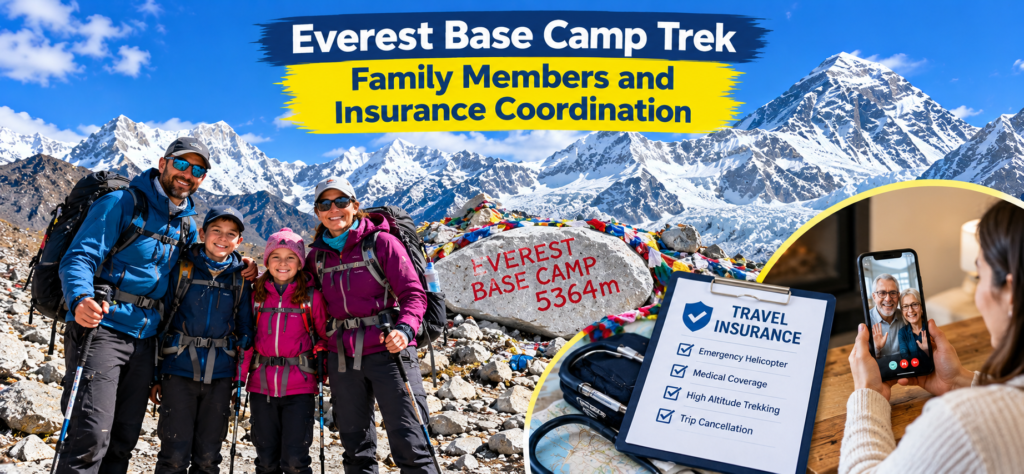
When multiple family members travel together, each person needs their own individual policy rather than relying on a single family plan that may not actually extend full coverage to every member for high-altitude trekking specifically. We have seen cases where a family assumed a shared policy covered everyone equally, only to discover during the claims review that coverage limits differed by individual within the same plan.
We recommend each traveling family member independently confirm their own policy’s altitude range and evacuation terms, even when purchasing through the same provider at the same time, simply because policy administration can vary by individual traveler even under one account.
A Final Word on Taking Insurance Seriously
Every year, a small number of trekkers across the Everest region attempt this trek with inadequate or no altitude-appropriate insurance, usually because they either did not realize their existing policy excluded high-altitude trekking or decided to save money by skipping it. The financial risk of this decision is significant: a helicopter evacuation from high in the Khumbu paid out of pocket can easily exceed ten thousand US dollars, and hospital treatment in Kathmandu for altitude-related complications adds further cost on top of that.
We treat proper insurance verification as seriously as we treat physical preparation and acclimatization planning, because all three are part of the same goal: giving every client the safest possible trek to Everest Base Camp. If you have any questions about what your current policy does or does not cover for this specific trek, reach out to our team before booking and we will help you understand exactly what to look for.
Comparing Annual Multi-Trip Policies to Single-Trip Policies
Frequent travelers sometimes already hold an annual multi-trip insurance policy and wonder whether it is sufficient for this trek rather than purchasing a separate single-trip policy. The answer depends entirely on whether the annual policy includes a high-altitude trekking add-on or rider, since most standard annual policies are built around general leisure and business travel and cap adventure activities at a much lower elevation than Everest Base Camp requires.
If your annual policy does include an adventure sports or high-altitude add-on, check the specific elevation cap it lists, since some riders top out around 4,000 or 4,500 meters, which would leave you uncovered above Dingboche or Lobuche. In most cases we find it simpler and safer for clients to purchase a dedicated single-trip policy specifically rated for Everest Base Camp trekking, even if they already hold an annual policy for other travel.
Currency and Payment Considerations for Claims
Most international insurers reimburse claims in the currency of the policy rather than the currency expenses were incurred in, which means a hospital bill paid in Nepali rupees or a helicopter charge invoiced in US dollars will be converted at the exchange rate applicable on the date of the claim, not necessarily the date of treatment. This can create a small variance between what was paid and what is reimbursed, which is worth understanding in advance rather than being surprised by after a claim is settled.
Some evacuation providers in Nepal are able to bill certain insurers directly, avoiding the need for the trekker to pay upfront and seek reimbursement later. Where this direct billing arrangement exists, it significantly reduces the financial burden during an already stressful situation, and it is worth asking your insurer specifically whether they have a direct billing relationship with evacuation and hospital providers in Kathmandu.
Why We Bring This Up Before You Even Book
We raise travel insurance early in the booking process, rather than waiting until final trip preparation, because purchasing appropriate coverage often works out better financially and in terms of available options the earlier it is arranged, and because some cancellation-related benefits only apply if the policy was purchased within a certain window after your initial trip deposit. Waiting until the last minute can mean missing out on cancellation protection for reasons that arise between booking and departure.
Our pre-departure documentation checklist includes insurance verification alongside permits, vaccination recommendations, and gear review, specifically so that this important but easy-to-overlook piece of preparation does not get left until the final days before flying to Nepal, when there is little time left to fix a coverage gap if one is found.
Common Mistakes Trekkers Make With Insurance
The most frequent mistake is purchasing a generic travel policy without checking the altitude exclusion clause at all, assuming that any travel insurance automatically covers any activity undertaken during the trip. The second most common mistake is under-declaring a pre-existing medical condition to secure a lower premium, which can void an entire claim if the condition later turns out to be relevant to a medical incident during the trek.
A third mistake we see occasionally is purchasing insurance after arriving in Nepal rather than before departure, which some insurers do not allow at all, and others only allow with a waiting period before coverage becomes active, potentially leaving the first days of a trip uninsured. Arranging coverage well before international departure avoids all three of these pitfalls.
Insurance FAQ for Everest Base Camp Trekkers
Does travel insurance for this trek need to specifically mention Everest Base Camp? Not necessarily by name, but it must cover trekking up to at least 5,550 meters and ideally state this elevation figure explicitly rather than using a vague phrase like “high-altitude trekking” that could be interpreted differently during a claims dispute.
Can I buy insurance after I have already started the trek? In most cases, no. The vast majority of insurers require the policy to be purchased and active before departure from your home country, and coverage generally cannot be added retroactively once a trip is underway.
What if my claim is denied? Most insurers have an appeals process, and having thorough documentation, including a guide incident report, medical records, and receipts, gives you the best chance of a successful appeal. Keeping our office informed during any medical incident also means we can supply supporting documentation if you need it for an appeal after returning home.
How Our Guides Support You Through an Insurance Emergency
If an evacuation or medical claim becomes necessary during your trek, our lead guide manages the on-ground coordination with your insurer, local hospitals, and evacuation providers, while our Kathmandu office handles communication with family members back home and any logistics needed to adjust the remaining group itinerary. This support continues after the trek as well, with our office able to provide incident reports and documentation to help your claim move smoothly.
This layer of support is one of the reasons we ask for insurance details so early in the booking process: it lets our team cross-check that your coverage matches what we would actually need to invoke on your behalf if something went wrong, rather than discovering a gap only in the middle of an emergency.
Closing Thoughts
Proper travel insurance is not a box to check quickly before departure, it is a genuine piece of trip safety infrastructure, on par with acclimatization planning and quality guiding. Take the time to read your policy’s altitude and evacuation terms carefully, confirm them in writing with your insurer, and bring the documentation with you on the trail. It is a small amount of preparation that protects against one of the largest financial and safety risks of high-altitude trekking.
If you are unsure whether a policy you are considering meets these standards, send us the policy document before you buy it and we will review the altitude and evacuation clauses with you, free of charge, as part of our standard pre-trip support. It is a small favor that has saved past clients from a costly gap in coverage discovered only after it mattered.
Ultimately, the goal of good insurance is the same as the goal of good guiding: to make sure that whatever happens on the mountain, you and your family are protected, and the trek remains the adventure you came for rather than a source of financial or medical risk left unmanaged.
Trekking to Everest Base Camp is, for most people, a once-in-a-lifetime journey through some of the most spectacular high mountain terrain on earth, and the right insurance policy is what lets you focus entirely on that experience rather than worrying about what would happen if something went wrong along the way.
Take the time to get this piece right before you fly, confirm your coverage in writing, pack the documentation, and let the rest of your preparation, from training to gear to itinerary planning, take center stage where it belongs.
Safe travels, and see you on the trail to Everest Base Camp.
Related EBC Trek Guides
Planning Your Everest Trek?
Get local expert advice on cost, itinerary and the best time to go.