Most trekkers who come to the Everest region stay in teahouses, the family-run lodges that line the trail from Lukla to base camp. The teahouse system is excellent. But there is another way to do this trek, one that puts you closer to the mountain environment and further from the shared dining rooms that come with the standard approach.
The Everest Base Camp camping trek uses fully self-sufficient camping accommodation throughout the journey. A full support team carries cooking equipment, tents, food supplies, and camp infrastructure. Each evening you arrive at a campsite rather than a teahouse. For certain trekkers, this changes the journey entirely.
What a Camping Trek to EBC Actually Involves
A camping trek to Everest Base Camp is not backpacking in the traditional sense. At altitude on this route, attempting to carry a full camping kit yourself would be both physically limiting and genuinely risky. Instead, camping treks use a support team of porters, camp staff, and a lead guide who transport and set up all equipment, cook all meals, and manage camp logistics from arrival to departure each day.
Your day as a camping trekker follows roughly the same pattern as the teahouse version. Wake time is early, breakfast is prepared by the camp cook, and you begin walking at roughly the same time as teahouse trekkers. The difference is what happens at the end of the day. Instead of walking into a teahouse dining room, you arrive at a pre-selected campsite where your tent is already pitched, tea is waiting, and dinner preparation is underway. You eat at a camp table with other members of your group, then sleep in a proper expedition tent with a sleeping mat and your own sleeping bag.
The camp crew wakes before you each morning to prepare breakfast and begin breaking down the camp. By the time you finish eating and pack your day bag, the porters are already loading equipment to move to the next campsite. The logistics are almost entirely handled for you. What you carry is your day pack with water, snacks, camera, and clothing layers.
Planning Your Everest Trek?
Get local expert advice on cost, itinerary and the best time to go.
Why Some Trekkers Choose Camping Over Teahouses
The reasons trekkers choose the camping format vary but tend to cluster around a few common themes.
Solitude and immersion are the most common. Teahouses on the main EBC route at peak season are busy, social, and often noisy. The common rooms fill with trekkers from a dozen countries, conversations overlap, and the feeling of being in a remote mountain landscape is occasionally disrupted by the very density of the trekking traffic. A campsite set away from the main teahouse clusters gives you evenings in a quality of quiet that does not exist inside a teahouse.
Flexibility in campsite selection is another factor. Camping trekkers can stop for the night at locations that the fixed teahouse infrastructure does not reach, including sites above and below the established teahouse villages that have particularly good views or particularly good separation from the main trail. The campsite at the edge of the terminal moraine above Lobuche, with unobstructed views of Nuptse and Pumori, is different from the teahouse room in Lobuche village in a way that is hard to articulate until you experience it.
Dietary control and food quality are reasons that some trekkers, particularly those with specific dietary needs or who are used to higher food standards, prefer the camping format. A dedicated camp cook for your group prepares meals specifically for your party using ingredients transported from lower elevations or sourced in Namche Bazaar. The food on a well-run camping trek is typically of higher quality and more varied than standard teahouse menus.
Group privacy is relevant for families, corporate groups, or parties that have specific reasons for wanting their own contained social environment rather than a shared teahouse setting. A camping trip gives your group complete control over your social space each evening.
The Camp Setup: What to Expect at Each Site
The quality and specifics of a camping setup vary by operator, but a well-run camping trek on the EBC route provides the following as standard.
Sleeping tents for trekkers are three or four-season designs with groundsheets and adequate insulation for the temperature range of the route. Above 4,000 metres, nighttime temperatures drop significantly below zero and your sleeping tent needs to provide genuine cold protection, not just a windbreak. Good camping operators use reputable tent brands with verified temperature ratings for the Himalayan environment.
A cook tent is set up separately from the sleeping area and serves as the kitchen and food preparation space for the camp crew. A dining tent with a folding table and camp chairs provides a sheltered eating space separated from your sleeping tents. This is where you eat meals, rest during the day if the weather is poor, and spend time with your group in the evenings.
A toilet tent is set up at each campsite with either a portable camp toilet or a designated dig site depending on the specific location. Managing human waste at altitude is one of the significant environmental challenges of camping in the Khumbu. Responsible camping operators follow leave-no-trace principles for waste disposal and use biodegradable products throughout the trip.
Hot water for washing and drinking is available from the cook tent at designated times, typically morning and evening. Many camping trekkers find the absence of hot showers less significant at altitude than at home, partly because you sweat less in cold conditions and partly because the physical tiredness of trekking leaves less energy for concerns about daily washing routines.
The Support Team Required for a Camping Trek
A camping trek requires significantly more support staff than a teahouse trek of the same size. Understanding the team structure helps you appreciate what the cost of camping trekking reflects.
The lead guide manages the overall trek, monitors health, leads the day’s walking, and makes the key decisions about pace, acclimatisation, and emergency response. This is the same role as on a teahouse trek but with the additional responsibility of coordinating with the camp crew on logistics and campsite selection.
The camp manager or sirdar is the senior member of the camp crew and manages the coordination between the cook, the porters, and the lead guide. On a large group trek, this is a separate role from the lead guide. On smaller group camping treks, the lead guide sometimes takes on both functions.
The camp cook is responsible for all meal preparation and manages the kitchen equipment, food supplies, and cooking schedule. A skilled camp cook is one of the most important members of the camping team. The quality of food on a camping trek depends entirely on their capability, creativity with limited ingredients at altitude, and understanding of the nutritional needs of high-altitude trekking.
Porters carry all the camping equipment, food, and personal gear beyond your day pack. A standard camping setup for a group of four trekkers typically requires eight to twelve porters depending on the distance between camps and the total weight being carried. The porter welfare standards applied by your trekking operator matter significantly. Reputable operators pay fair wages, provide appropriate equipment, cover insurance, and respect the load limits set by Nepal trekking industry regulations.
Planning Your Everest Trek?
Get local expert advice on cost, itinerary and the best time to go.
Acclimatisation on a Camping Trek
The acclimatisation requirements for a camping trek are identical to those for a teahouse trek on the same route. The same altitude thresholds, the same rest day schedule, and the same medical monitoring apply. Having your own camp cook means that nutrition management during acclimatisation is slightly easier to control, since meals can be specifically designed to support altitude adaptation rather than selected from a standard teahouse menu.
The temperature management difference between camping and teahouses is worth noting. Teahouse common rooms, even basic ones, provide shared warmth in the evenings that camping does not replicate. Expedition-weight sleeping bags rated to minus fifteen or below are essential for camping above 4,000 metres on this route. The cold does not compromise safety on a properly equipped camping trek, but it does require more deliberate planning around warmth than the teahouse alternative.
Campsite Locations on the EBC Route
Camping on the EBC route uses a combination of established campsites near villages and more remote sites away from the teahouse infrastructure. The specific campsite selection depends on your itinerary, your group size, and the time of year.
Near Namche Bazaar, camping is typically in designated areas near the village rather than inside it. The Khumjung area above Namche offers particularly good camping sites with views toward Ama Dablam and Thamserku. In peak season, these sites may be shared with other camping groups, though the density is far lower than the teahouse accommodation scene in Namche itself.
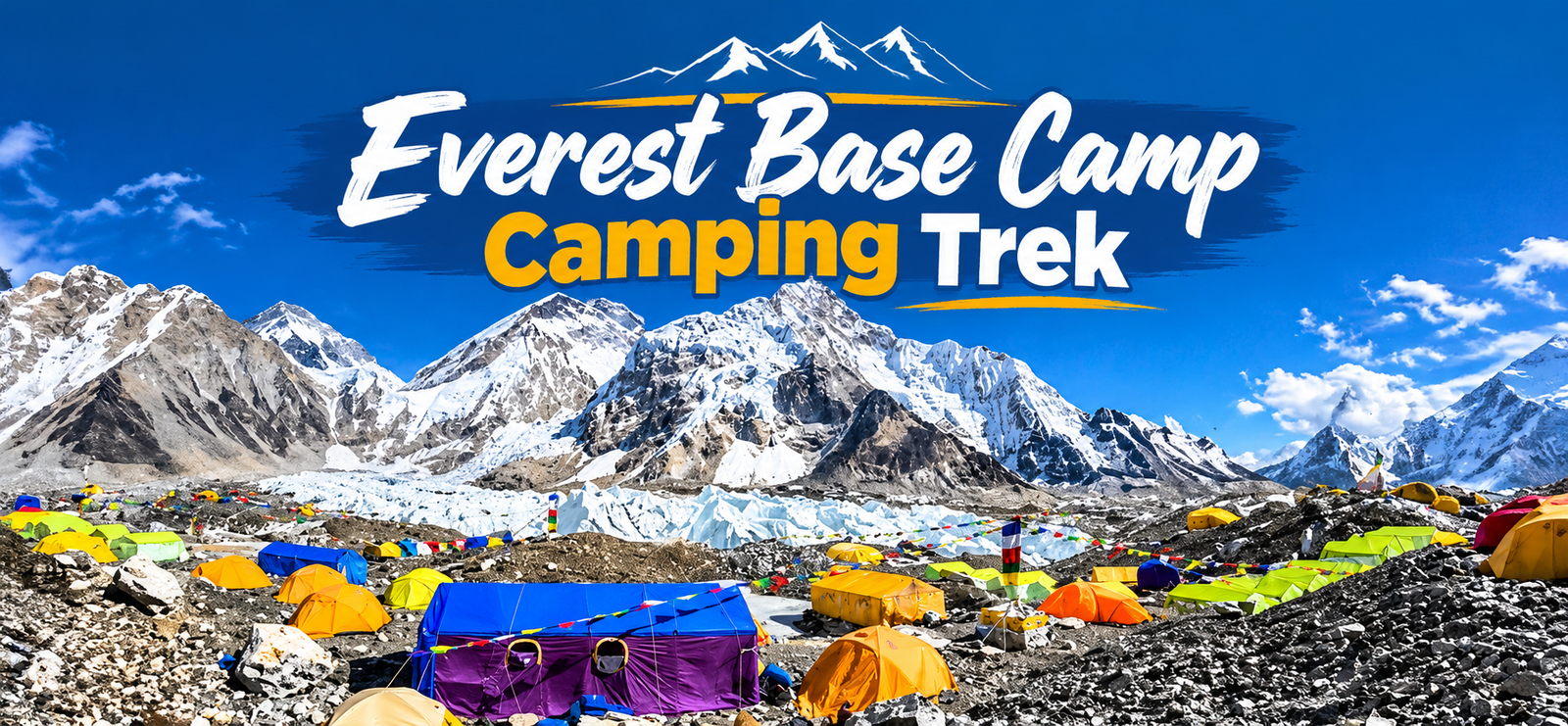
The campsite at Gorakshep, the last stop before base camp, is one of the most atmospheric camping locations on the route. Set at 5,164 metres with Pumori and the Khumbu glacier as immediate neighbours, camping here rather than in the teahouses puts you directly in the mountain environment that the entire trek has been moving toward.
At base camp itself, during the expedition season from March to May, the camp is occupied by climbing expeditions and is not available for trekking campsites. Outside expedition season, camping near base camp is possible and creates an experience of the site that is qualitatively different from the daytime teahouse trekker visit.
Cost of a Camping EBC Trek vs Teahouse Trek
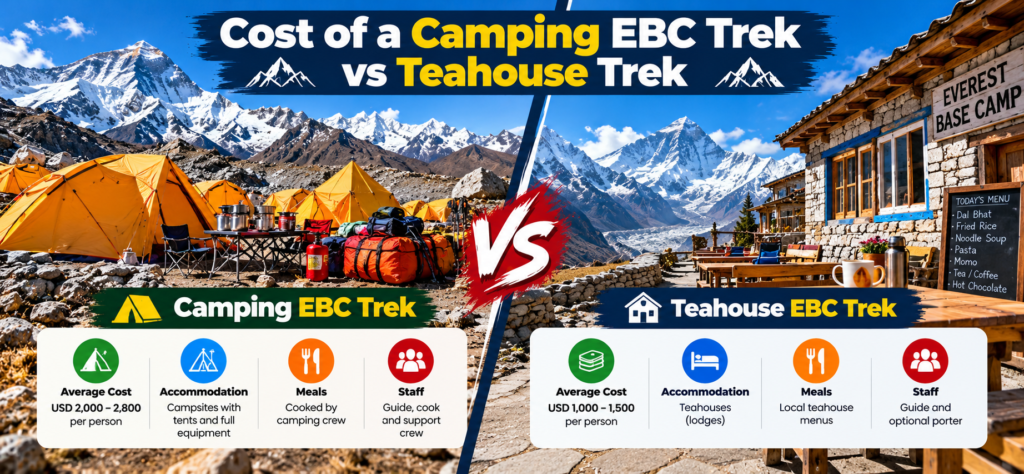
Camping treks to Everest Base Camp cost more per person than equivalent teahouse treks, typically by a meaningful margin. The reason is the larger support team required: more porters, the camp crew, the cook, and the additional equipment all add to the operating cost of the trek.
For a small group of two to four trekkers, the per-person cost of a privately arranged camping trek is significantly higher than a teahouse trek because the fixed costs of the camp infrastructure and crew are distributed across fewer people. For larger groups of eight or more, the per-person cost difference narrows as those fixed costs are shared more widely.
If you are considering a camping trek for a specific reason that justifies the additional cost, the investment is worthwhile. If the main appeal of camping is the experience of sleeping under canvas in the Himalayan night, that is a valid and deeply enjoyable reason. If the appeal is primarily cost-saving, a teahouse trek is the more practical choice.
Permits for Camping in the Khumbu
Camping within Sagarmatha National Park requires the standard national park entry permit that all trekkers need, plus any specific camping fees required by park regulations. Your trekking operator handles all permit acquisition as part of the package. Confirm that camping permissions for your specific planned sites are included in the pre-departure planning.
Some campsites within the park, particularly those near villages, involve a small local fee paid to the community or the Sagarmatha Pollution Control Committee. These fees are part of the environmental and community benefit system that makes managed camping in the park possible. Your operator includes these in the trip budget.
Is a Camping Trek Right for You?
The camping format suits trekkers who prioritise solitude, immersion, and a different quality of experience from the standard teahouse route. It suits groups that want private social space throughout the trek. It suits trekkers who have done the teahouse version of this route and want a fundamentally different experience of the same landscape.
It is worth being honest with yourself about one aspect of the camping experience: cold nights at high altitude in a tent are genuinely less comfortable than sleeping in a teahouse room, even a basic one. The experiential trade-off, extraordinary silence and mountain proximity versus more warmth and teahouse community, is real. Both are valid choices. Neither is the objectively better way to do this trek.
At Everest Trek Company, we offer both teahouse and camping formats for the Everest Base Camp route. Our camping treks use experienced camp cooks, quality tents, and crew who are familiar with the logistics of high-altitude camping in the Khumbu. If you want to experience base camp from inside a tent with the mountain right outside your door, we can make that happen.
The Khumbu at night, away from the teahouse lights, under a sky that has no competition from light pollution at 5,000 metres above sea level, is something different from any mountain experience you have had closer to civilisation. That is what a camping trek offers. Whether it is what you are looking for is the question worth answering before you book.
Planning Your Everest Trek?
Get local expert advice on cost, itinerary and the best time to go.
How Camping Treks Differ From Teahouse Treks Logistically
A camping trek to Everest Base Camp involves a full support crew, including a cook team, kitchen staff, and camping crew responsible for setting up and breaking down tents each day, in addition to the guide and porters found on a standard teahouse trek. This significantly larger support operation is what allows camping treks to venture onto less developed routes without relying on the established teahouse infrastructure that exists along the classic route.
Meals on a camping trek are prepared by a dedicated kitchen team traveling with the group, often producing surprisingly varied and high-quality food given the remote conditions, a genuine point of pride for many established camping trek operators who take real care in this aspect of the experience.
Who Should Consider a Camping Trek
Camping treks suit trekkers specifically interested in more remote, less-trafficked routes than the classic Everest Base Camp trail, those seeking a more traditional expedition-style experience, or groups wanting maximum control over their itinerary and schedule independent of teahouse availability. It is generally not necessary, and adds unnecessary cost and complexity, for trekkers simply wanting to reach Everest Base Camp via the standard, well-developed route.
We generally recommend the standard teahouse trek for most clients given the well-developed infrastructure and lower cost along the classic route, reserving camping trek recommendations specifically for clients with a genuine interest in remote route variations or a particular expedition-style experience they are seeking.
Cost Comparison: Camping Versus Teahouse Treks
Camping treks are meaningfully more expensive than teahouse treks, reflecting the considerably larger support crew, camping equipment, and food logistics required. Trekkers considering this option should budget significantly above standard teahouse trek pricing, discussed in our dedicated cost guide, to account for this added operational complexity and crew size.
We provide detailed, itemized quotes for camping trek options on request, helping clients understand exactly what drives the higher cost and whether the specific benefits of a camping-based itinerary genuinely justify that additional expense for their particular goals and route preferences.
Camping Equipment: What Is Provided
On a fully supported camping trek, the operator typically provides sleeping tents, a dining tent, a kitchen tent, and all necessary cooking and eating equipment, while trekkers are generally responsible for their own sleeping bag and personal gear, similar to a teahouse trek. Some operators offer sleeping bag rental as part of the package, worth confirming specifically when comparing camping trek options.
Tent quality and camp setup standards vary meaningfully between operators, and we recommend asking specifically about tent insulation rating, sleeping pad provision, and overall camp comfort standards when evaluating a camping trek option, since these details significantly affect the actual experience of a multi-week camping-based itinerary.
Remote Routes Accessible via Camping Treks
Camping treks open up route options beyond the standard teahouse-supported trail, including more remote approaches through less-visited valleys, extended circuits combining multiple viewpoints and passes, or expedition-style itineraries supporting a peak climbing objective in areas without teahouse infrastructure. These routes offer a genuinely different experience of the Khumbu region, away from the busier sections of the classic trail.
If a specific remote route or extended circuit is your primary motivation for considering a camping trek, we can discuss which specific routes are realistically supportable via camping logistics and what the resulting itinerary, cost, and time commitment would look like for your particular interests.
Weather and Comfort Considerations for Camping Treks
Camping treks expose trekkers to weather conditions more directly than teahouse treks, since a tent offers less insulation and protection from cold than a teahouse building, particularly at higher elevations where nighttime temperatures drop significantly. A quality four-season tent and an appropriately rated sleeping bag and sleeping pad become even more critical on a camping trek than on a standard teahouse itinerary.
We are direct with clients considering a camping trek about this added exposure to the elements, since going in with realistic expectations about comfort levels is important for a positive overall experience on this more rugged style of trekking.
Crew Size and Group Dynamics on a Camping Trek
The full support crew on a camping trek, cooks, kitchen staff, camping crew, guide, and porters, is considerably larger than the staffing on a teahouse trek, creating a genuinely different social dynamic with a larger traveling community around the trekking group each evening. Many clients who choose camping treks specifically enjoy this fuller expedition atmosphere as part of the overall experience.
This larger crew also means more jobs supported within the local economy per trek, and we take the same care with fair wages and proper insurance for our camping crew as we do for our standard teahouse trek staff, an important consideration we do not compromise on regardless of trek style.
Acclimatization on a Camping Trek
The same acclimatization principles that govern our standard teahouse itinerary, gradual ascent and dedicated rest days, apply equally to any camping trek itinerary we run, and we do not compromise on acclimatization schedule simply because a route lacks teahouse infrastructure. If anything, more remote camping routes sometimes require even more conservative pacing given the greater distance from emergency evacuation points along less-trafficked trails.
Our guides bring the same altitude monitoring practices, discussed in our dedicated altitude sickness guide, to camping treks as they do to standard teahouse itineraries, ensuring this critical safety consideration is not diminished simply because the accommodation style has changed.
Environmental Considerations for Camping Treks
Camping treks in remote areas carry additional environmental responsibility, since campsites lack the established waste management infrastructure of teahouse villages, and we follow strict Leave No Trace practices on every camping-based itinerary we operate, packing out all waste and minimizing our footprint in these more pristine, less-visited areas.
This environmental care is especially important on remote routes precisely because they see less regular traffic and correspondingly less established infrastructure for managing the environmental impact of trekking groups passing through, making responsible practice by every operator using these routes genuinely important for their long-term preservation.
Combining Camping and Teahouse Sections
Some itineraries combine both styles, using teahouses along the well-developed sections of a route and camping for remote extensions or peak climbing approaches that lack teahouse infrastructure, offering a practical middle ground between the comfort of established teahouses and the flexibility camping provides for reaching less-developed areas. This hybrid approach is common for trekking peak expeditions that combine a standard trek approach with a camping-based summit push.
We can design a custom hybrid itinerary for clients interested in this combined approach, taking advantage of teahouse infrastructure where it exists and camping logistics specifically for the sections where it genuinely adds value or access to terrain otherwise unreachable via the standard route.
Physical Demands of Camping Treks Versus Teahouse Treks
Camping treks are not inherently more physically demanding in terms of daily walking distance, but the overall experience does involve additional physical elements: helping with or simply navigating camp setup and breakdown routines, potentially colder overnight conditions, and often more remote, less-maintained trail sections than the well-trodden classic route. Trekkers should factor these additional demands into their overall preparation and expectations.
Our training guide’s general principles apply equally to camping trek preparation, though we recommend slightly more conservative expectations around comfort and convenience given the more rugged nature of this style of trekking compared to the standard teahouse route.
Questions to Ask Before Booking a Camping Trek
Ask specifically about tent quality and insulation rating, the crew’s experience with the specific remote route being considered, food quality and variety on multi-week itineraries, and exactly how the operator handles emergency evacuation from more remote camping locations farther from established teahouse infrastructure and easier helicopter access points. A confident, detailed answer to each of these questions is a good sign of a genuinely well-prepared camping trek operator.
We are glad to answer these questions in detail for anyone considering a camping trek with us, since the specific logistics and preparation required differ meaningfully enough from a standard teahouse trek that a thorough understanding before booking genuinely matters for a successful experience.
Our Honest Recommendation
For most clients whose primary goal is simply reaching Everest Base Camp and Kala Patthar via the classic route, we recommend the standard teahouse trek, which offers a well-tested, comfortable, and more cost-effective path to the same iconic destination. We reserve camping trek recommendations for clients with a specific interest in remote route variations, peak climbing expeditions requiring camping logistics, or those genuinely seeking the particular expedition-style character that camping provides.
We would rather guide you toward the trek style that genuinely fits your goals and preferences than default to recommending whichever option happens to be more elaborate or expensive, and we are always glad to have a direct conversation about which approach makes the most sense for what you are hoping to experience.
Whether you ultimately choose a standard teahouse trek or a fully supported camping expedition, both styles can deliver an unforgettable journey through the Khumbu region, and the right choice comes down entirely to your specific goals, budget, and appetite for a more rugged, self-sufficient style of travel.
Reach out to our team to discuss which approach best fits what you are hoping to get out of your Everest Base Camp journey, and we will help you plan accordingly, whether that means the classic teahouse route or a more remote camping-based itinerary.
Camping treks are not for every trekker, and that is entirely fine; the classic teahouse route delivers the same core Everest Base Camp and Kala Patthar experience at lower cost and with fewer logistical complications for the majority of people who simply want to complete this bucket-list trek.
But for those with a genuine draw toward a more remote, expedition-style experience, or a specific route or peak climbing objective that requires it, a well-run camping trek can offer something the standard route simply cannot: true solitude on trails far from the crowds of the classic Everest Base Camp path.
Whichever path you choose, our team brings the same commitment to safety, fair treatment of local staff, and genuine expertise in the Khumbu region to every trek we run, camping or teahouse-based alike.
We look forward to helping you plan the version of this journey that best matches what you are truly looking for, whether that is comfort and reliability or a more rugged, remote adventure into the less-traveled corners of this extraordinary mountain landscape.
Contact us with your questions about camping versus teahouse trekking, and let us help you decide which style fits your priorities, budget, and sense of adventure best.
We are always glad to talk through the tradeoffs in detail and help you make a confident, well-informed decision before you commit to either style of trek.
Whatever you decide, the mountains of the Khumbu await, and we would be honored to guide you there safely, whichever path you choose to take.
Reach out to us today, and let’s start planning the right version of this trek for you.
We look forward to hearing about your goals and helping you find the best fit.
Talk to us soon, and let’s make it happen.
Thank you for reading, and best of luck deciding on the version of the Everest Base Camp journey that is right for you.
We are here whenever you are ready.
Let us know how we can help with the next steps of your planning journey.